Relevant standards for dispensing equipment depend on its machine design, installation region, workplace conditions, and manufacturing application. Common frameworks include ISO 12100 for machinery risk assessment and ISO 9001 for quality management. Selecting an adhesive dispensing system involves more than checking placement accuracy or production speed; manufacturers must also consider chemical handling, equipment guarding, contamination control, and documented process verification.
Axxonauto operates in a sector where these requirements intersect with precision automation, making standards awareness an important part of equipment evaluation and production planning.
What Standards Apply to Dispensing Equipment Operations?
Dispensing equipment may fall under several regulatory and technical frameworks, depending on its design, installation location, materials, and intended use. Machinery safety requirements address hazards such as moving stages, pinch points, electrical faults, and unexpected startup. In the European Union, applicable machinery legislation and harmonized standards help manufacturers assess conformity, while US workplaces may need to follow relevant Occupational Safety and Health Administration requirements.
ISO 12100 provides a widely used framework for machinery risk assessment and risk reduction. Its approach begins with identifying hazards, estimating and evaluating risks, and applying suitable protective measures. For dispensing applications, this may involve examining motion axes, pressurized fluid lines, heated components, maintenance access, and potential exposure to hazardous substances.
Quality management standards address a different but related concern: whether manufacturing processes are consistently controlled and documented. ISO 9001 establishes general quality management principles, including process monitoring, documented information, corrective action, and continual improvement. It does not certify that every deposit is defect-free, but it can help organizations establish a structured system for managing production quality.
| Standard / framework | Main focus | What it does not prove |
| ISO 12100 | Machinery risk assessment and risk reduction | Not a product certification or compliance mark |
| ISO 9001 | Quality management system | Not a guarantee that every deposit is defect-free |
| IATF 16949 | Automotive quality management requirements | Not applicable to every industry or product |
How to Handle Operator Protection in Dispensing Equipment?
Adhesives, sealants, solvents, primers, and cleaning agents can present different risks depending on their composition. Some materials may release irritating vapors, cause skin sensitization, or require specific temperature and storage controls. Safety data sheets provide essential information about hazards, personal protective equipment, exposure controls, first aid, and spill response.
Risk controls should reflect the actual substances and operating conditions rather than relying on generic precautions. Local exhaust ventilation may be necessary for certain volatile chemicals, while closed material containers can reduce contact and contamination. Appropriate gloves, eye protection, and other protective measures should be selected according to the chemical supplier’s recommendations and the workplace risk assessment.
Machine safeguards also deserve careful attention. Emergency stops, interlocked access panels, electrical protection, and safe maintenance procedures can reduce risks associated with automated motion and pressurized delivery systems. Where heating stages are involved, thermal hazards and temperature control require additional consideration. Operators should receive training on startup, shutdown, cleaning, fault recovery, and the safe handling of dispensing materials.
How to Verify Quality and Validate Dispensing Equipment?
Reliable dispensing depends on measurable acceptance criteria rather than visual judgment alone. Depending on the application, quality checks may examine deposit volume, bead width, position, coverage, repeatability, or curing performance. Semiconductor packaging and electronics assembly may require additional tests because defects can be concealed beneath components or within bonded interfaces.
Calibration and verification serve distinct purposes. Calibration establishes the relationship between an instrument’s readings and reference standards, while verification determines whether equipment or a process meets specified requirements. Manufacturers should define appropriate intervals based on equipment stability, usage, material characteristics, and the consequences of process variation. Records should capture the method, results, acceptance criteria, and corrective action when a check fails.
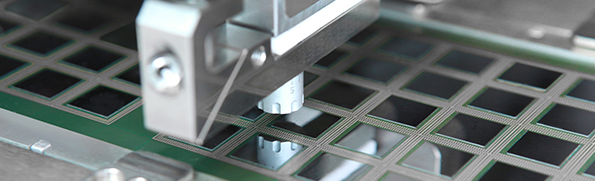
The MYD50S is a three-stage-heating, high-speed inline dispensing system designed for precision chip-packaging applications in the semiconductor industry. Its stated features include a linear-motor motion system with closed-loop control, a micron-resolution grating scale, a user-friendly interface, and a work area of up to 350 × 500 mm. These technical capabilities are relevant when evaluating motion precision and temperature-related process requirements, but compliance with any particular safety or quality standard must be confirmed separately through the applicable documentation and assessment.
How to Verify Quality and Validate Dispensing Equipment?
Standards compliance is not a one-time equipment inspection. Manufacturers need documented procedures covering installation, operation, maintenance, cleaning, material changes, and abnormal conditions. Traceable records help teams investigate defects, demonstrate that checks were performed, and identify whether a failure originated from the material, equipment, process settings, or operator practices.
Industry-specific requirements may add further obligations. Automotive electronics suppliers, for example, may work within quality management frameworks such as IATF 16949, while medical-device manufacturing may require controls aligned with ISO 13485 and applicable regulatory requirements. These standards are not interchangeable, and their applicability depends on the product, customer, and manufacturing context.
A practical compliance review should map each requirement to evidence. This may include risk assessments, declarations of conformity where applicable, electrical test records, material safety documentation, calibration records, validation reports, and operator training logs. Dispensing equipment should be assessed against the requirements that genuinely apply to its installation and use, rather than assumed compliant because it contains advanced automation features.
Conclusion
Effective safety and quality management combines appropriate standards, sound equipment design, validated processes, and disciplined documentation. Manufacturers that define applicable requirements early can reduce uncertainty during installation and production audits while making responsibilities clearer for engineering, quality, and operations teams.
Axxonauto works within the precision dispensing sector, where technical capability must be considered alongside application-specific risk assessment and verification. The final compliance decision rests on documented evidence, relevant regulations, and the actual conditions in which the equipment operates.
FAQs
Which Standards Are Relevant to Dispensing Equipment?
Commonly relevant frameworks include ISO 12100 for machinery risk assessment and ISO 9001 for quality management. Other requirements may apply depending on the region, machine design, workplace, and industry.
Does an Automated Dispensing Machine Automatically Meet Safety Standards?
No. Automation alone does not establish compliance. The machine and its installation must be assessed against applicable requirements, including electrical safety, moving parts, chemical exposure, guarding, and maintenance risks.
How Often Should Dispensing Equipment Be Calibrated?
There is no universal interval for every system. Calibration frequency should reflect manufacturer recommendations, process stability, usage, measurement requirements, and the consequences of inaccurate dispensing.