Two transmitters can look similar from across a job site and still be built for entirely different jobs. One sends a simple stop-or-go signal with each press; the other reads continuous, variable input as an operator tilts it forward, back, or sideways. Deciding between a joystick transmitter and a push-button unit isn’t about which is more advanced — it’s about matching control method to the actual motion the machine needs to perform.
Two Different Ways of Sending a Command
Moving from a hanging pendant to a radio transmitter lets the operator stand in a safer position, but the transmitter still has to match how the machine moves. A push-button transmitter sends discrete commands, and its buttons are self-resetting, so the function runs only while the button is held. A button can carry one function (single-speed) or two functions (two-speed). A joystick transmitter reads the position of the stick and turns it into a command. Depending on the joystick type, that command is a proportional value, an on/off signal, or a fixed gear. This difference drives most of the other differences between the two formats, from panel layout to typical use.
Push-Button Transmitters: Simplicity by Design
Push-button units suit tasks where each motion is a fixed direction: lifting, lowering, and moving a hoist or crane along its path. A single-speed button triggers one function. A two-speed button carries two functions on the same key, so one button can serve two speeds. Techwell’s BES08 is an 8-button, single-speed transmitter in the Bull Series, built for simple crane and hoist operations. It has eight self-resetting pushbuttons and runs on two standard AA batteries, which can be swapped on site. The company positions it for facilities that want dependable wireless control without joysticks or displays.
Joystick Transmitters: Built for Coordinated, Variable Motion
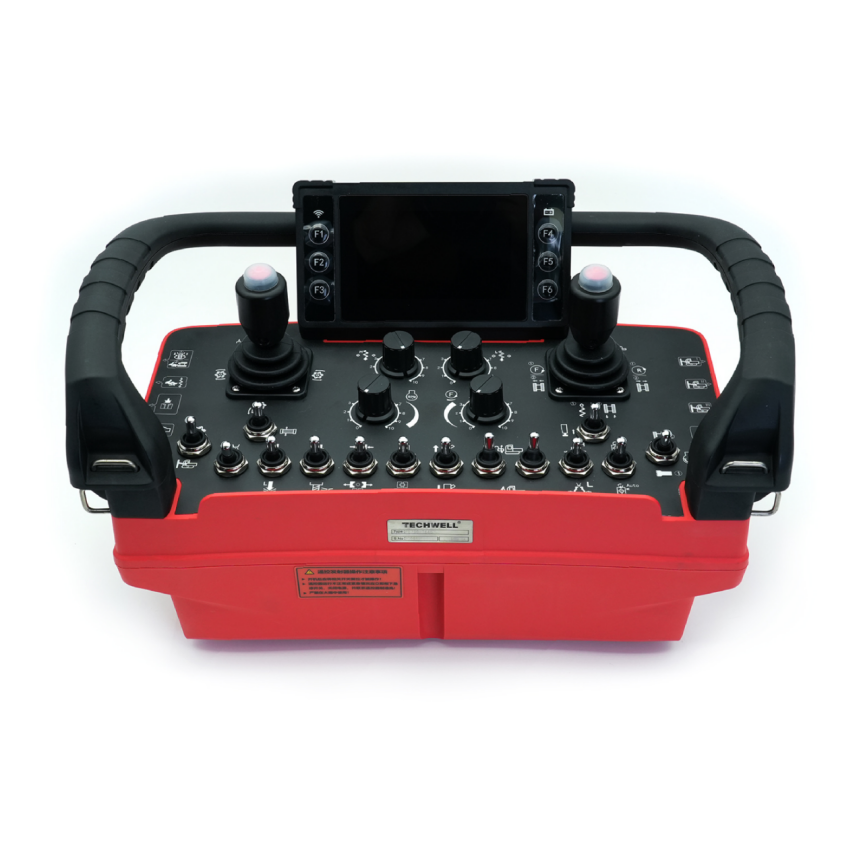
Joysticks take on work where a machine must move gradually, or where two motions happen at once, such as extending and rotating a boom together. Techwell’s BLJ20 is a large shoulder-mounted industrial radio remote control in the dual-axis joystick version of the Bull range. Its operation modes combine joysticks with toggle switches, pushbutton switches, and rotary switches, and it can be fitted with a 3″, 4.3″, or 7″ display. Optional features include an identification card, a 3-axis sensor, and video feedback.
Joysticks can be sorted in two ways. By function, a proportional joystick sends a value that scales with how far the stick is pushed. A switch-type joystick sends an on/off signal, like a button on a stick. A gear joystick moves between fixed steps, with configurations offered from one to five gears. By travel path, a single-axis joystick moves along one line, while a cross joystick moves along two perpendicular axes, so one stick can command two motions.
Comparing Physical Form and Ergonomics
Size and wearing style tend to follow control complexity. The BES08 stays compact because it needs no joystick assembly or switch banks, and it is held in one hand. A joystick transmitter like the BLJ20 needs a larger surface for its joysticks and mixed switch layout. It measures 396 × 234 × 216 mm and weighs 3.2kg without the battery, which is why it is worn on the shoulder rather than carried.
Frequency, Range, and Signal Design
The BES08 transmits on a single 429MHz–459MHz band. The BLJ20 is a dual-band unit covering 433 MHz (427.000–436.300 MHz) and 470 MHz (472.350–485.775 MHz), which gives users a second band to work with where several pieces of equipment transmit nearby. Both models are specified for a wireless range of ≥150 meters, so distance does not separate them. The band and the motion the machine needs matter more.
Durability: Both Models Are Rated IP66
Techwell’s published figures for both the BES08 and the BLJ20 list IP66 protection and an operating range of -25°C to 70°C, with humidity up to 97% RH (non-condensing). In these two models, then, durability does not depend on whether the control method is buttons or a joystick. Other models in the range can differ, so protection class, temperature range, and housing should still be confirmed on the spec sheet of the unit being ordered.
Matching Transmitter Type to the Application
A push-button transmitter fits operations where each motion has a fixed direction at one or two speeds, which describes many hoist and overhead crane jobs. A joystick transmitter fits hydraulic equipment and machines that need smooth, proportional, stepped, or simultaneous movement, and the display option helps where live status feedback matters. Techwell Remote Control offers both formats, because no single control method fits every machine equally well.
Conclusion
The right transmitter starts with how the machine moves. If every motion is a fixed direction at one or two speeds, a push-button unit, single-speed or two-speed, is usually enough. If the machine needs proportional, stepped, or simultaneous motion, a joystick configuration fits better, and the joystick type (proportional, switch-type, or gear; single-axis or cross) should follow the motion the machine actually makes. Frequency band, size, and environmental ratings then need to be confirmed on the spec sheet of the chosen model, such as the BES08 or BLJ20, because they vary by model rather than by control format.