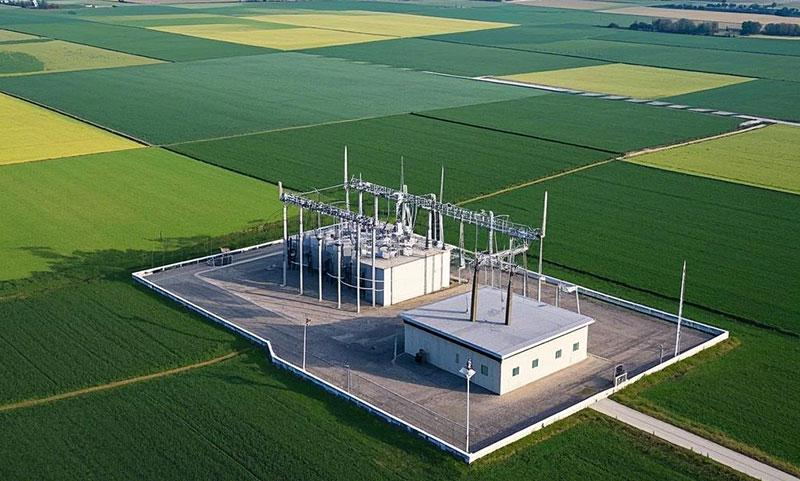
As renewable generation and battery storage take a larger share of local power production, some microgrids have less rotating generation available to stabilize voltage and frequency. Weak utility connections can create a similar challenge: although the external grid remains available, voltage and frequency support may become less robust during disturbances, depending on network strength and operating conditions.
A grid forming microgrid inverter is designed for this environment by contributing an active voltage and frequency reference rather than depending entirely on one supplied from elsewhere. Effective grid resilience solutions therefore require more than bidirectional energy conversion; they need dynamic support functions, transition capability, protection coordination, and evidence that the equipment can satisfy the interconnection rules of the target market.
Voltage and Frequency Form the First Layer of Support
The defining task of a grid-forming converter is to establish or sustain local electrical conditions when the surrounding network cannot do so reliably. Voltage magnitude and frequency must remain within usable limits while generation and load change.
Control methods such as virtual synchronous generator behavior and droop control can adjust active and reactive power in response to system conditions, allowing multiple resources to share load without relying on a single stiff grid reference.
A grid forming microgrid inverter also needs sufficient dynamic response so abrupt demand changes do not translate directly into unacceptable voltage or frequency excursions. Rated power is only part of that capability.
Short-duration overload, current limits, and unbalanced-load behavior matter because real microgrids contain motor starts, single-phase loads, and sudden changes that do not resemble steady-state laboratory conditions. The converter has to remain controlled while these events occur rather than simply deliver nominal power under balanced conditions.
Volt-VAR and Volt-Watt Functions Address Grid Interaction
Reactive-power response becomes important when voltage starts to move outside its preferred range. Volt-VAR functions can change reactive power according to measured voltage, while Volt-Watt behavior can reduce or adjust active power as voltage conditions require.
These functions are especially relevant to grid resilience solutions connected to networks with high penetrations of inverter-based generation because local voltage can change as solar or storage output varies. Such functions do not replace grid-forming control; they address a different layer of behavior.
Grid-forming operation concerns the establishment and dynamic support of the electrical reference, while Volt-VAR and Volt-Watt functions shape how the inverter interacts with a connected grid under specified conditions. Project requirements determine which functions are mandatory and how their settings are coordinated with utility protection and local control.
Transitions Between Grid-Connected and Islanded States
A microgrid that can operate both with and without the utility needs a controlled transfer between those states. Synchronization, breaker status, battery reserve, load level, and protection logic all influence the transition. Within the MGC MK3, WidenEdge combines VSG and droop functions with grid-forming control, allowing operation to move between grid-following and grid-forming modes.
Transition support also includes seamless transfer between grid-connected and off-grid states; load-fluctuation response, synchronization, and rapid reaction to sudden load changes are handled within the same operating framework. Those capabilities matter because a grid forming microgrid inverter can be required to take over the local electrical reference immediately after a grid disturbance.
In off-grid operation, the MGC MK3 uses grid-forming control to support the local voltage and frequency reference when utility power is unavailable. Its 100% unbalanced-load capability allows the inverter to serve systems where demand differs considerably between phases.
WidenEdge’s related weak-grid solution also specifies 1.5-times overload for three seconds, together with external current and voltage sampling. These functions address different needs: maintaining the electrical reference, accommodating uneven loads, and providing short-term capacity and load information during sudden demand changes.
Interconnection Compliance Affects Project Approval
North American projects also have to treat grid-support behavior as a compliance issue. Requirements associated with UL 1741 SB and, in California, CSIP can influence how inverter functions are tested, documented, configured, and accepted for interconnection.
The engineering question is therefore not only whether a control function exists, but whether the required behavior can be demonstrated under the applicable utility and jurisdictional process. A technical feature list and a compliance record serve different purposes, so both need to be reviewed during project planning.
This distinction is particularly important for systems that combine grid-connected operation with intentional islanding. Protection settings, reconnect logic, abnormal-voltage and abnormal-frequency response, and utility communication requirements can affect commissioning schedules and approval. Certification or compliance status has to be established for the exact equipment model and project jurisdiction; general product functionality alone does not establish that status.
Commissioning plans also need to account for utility witness tests, settings files, communications requirements, and any site-specific studies. These procedural items can affect project schedules even when the underlying inverter functions are technically capable of supporting the grid.
Grid Support Has to Work at System Scale
For unstable low-voltage networks, WidenEdge’s weak-grid design combines parallel operation of up to 32 units with flexible AC- and DC-side coupling. Its application scope includes rural microgrids, emerging-region networks, off-grid islands, mining sites, irrigation systems, and rural electrification.
In these settings, grid resilience solutions depend on coordinated response from converters, storage, local controllers, and other generation rather than on a single device working in isolation. A capable grid forming microgrid inverter provides the electrical foundation, but reliable operation comes from matching that foundation to load behavior, protection, communications, interconnection requirements, and the strength of the network around it.
SEO Title: What Grid Support Capabilities Should a Grid-Forming Microgrid Inverter Provide? | WidenEdge
Meta Description: Read our latest insights on What Grid Support Capabilities Should a Grid-Forming Microgrid Inverter Provide? Explore voltage, frequency, and grid interaction.