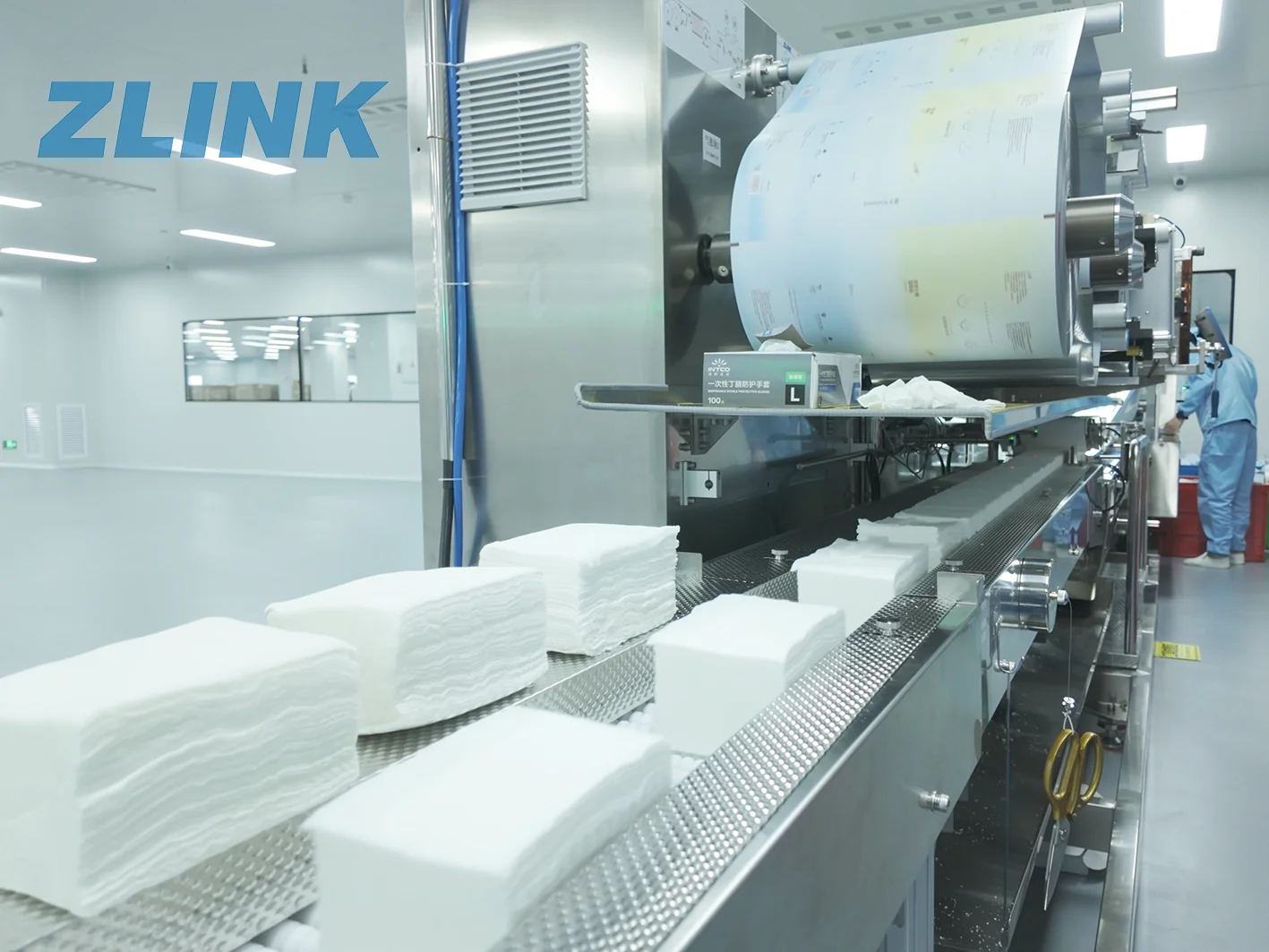
Maintaining smooth coordination between primary converting units and downstream packaging machinery represents a critical operational goal for industrial wet wipe manufacturing plants. Production managers and engineering supervisors evaluating line balance focus on motion control synchronization, dynamic stack buffering, and servo indexing to prevent material pileups or idle machine cycles across long shifts. Establishing harmonized speed management between unwinding, liquid dosing, transverse cutting, and flow wrapping protects product integrity while maintaining steady factory throughput. As an established wet wipes production line supplier, ZLINK configures fully automated machinery architectures designed to support stable material transitions and optimize overall equipment effectiveness across demanding production environments.
Evaluating Converting Velocity and Downstream Packaging Capacity Mechanics
The primary converting stage processes continuous dry nonwoven webs into saturated folded wipe stacks, establishing the baseline linear velocity for the entire processing line. Driven traction rollers pull nonwoven sheets through longitudinal folding plates and rotary cutting assemblies, producing consistent stack counts that advance toward primary wrapping corridors.
When comparing converting and packaging capacities, teams may review cutter frequency, stack count, film index, and buffer length. ZLINK wet wipes production line configurations can be discussed around these variables. Checking speed change scenarios and jam recovery access can help support predictable transfer without treating one line speed as suitable for every product.
If downstream flow wrapping machinery cannot match the output frequency of upstream crosscutters, folded wipe stacks accumulate along transport belts, causing geometric deformation or machinery jams. Configuring an adaptable wet wipes production line allows factory engineers to align processing lane speeds with packaging indexing rates, ensuring predictable product transfer without structural fabric distortion.
Dynamic Indexing Conveyors and Buffer Zone Management Architecture
Integrating intelligent indexing conveyors between rotary cutting units and primary flow wrapping modules creates a flexible mechanical buffer that compensates for speed variations. Multi axis servo controllers manage belt acceleration constantly, adjusting stack spacing dynamically to match the incoming velocity of primary packaging film enclosures.
Buffer reviews may include conveyor length, sensor spacing, stack height, and film splice timing. ZLINK indexing conveyor options can be planned with servo control and sensor feedback suited to the layout. Reviewing these details can help support steady stack spacing during routine speed changes and film roll changes.
Dynamic sensor arrays monitor stack arrival timing along transport corridors, transmitting speed signals to downstream wrapping drives to maintain steady flow pack spacing. Utilizing intelligent buffer mechanisms prevents sudden line stoppages during packaging film roll splicing, allowing converting units to maintain steady unwinding and wetting parameters without continuous manual adjustments.
Closed Loop Servo Motion Control and Dynamic Film Tension Alignment
Synchronizing primary converting speeds with flow wrapping machinery relies heavily on closed loop servo motion controllers that process encoder data from both operational stages. As primary converting drive shafts change speed during acceleration or deceleration phases, packaging servo drives adjust film unwinding rates and thermal sealing jaw rotation simultaneously. Dynamic tension controllers maintain uniform film pull across longitudinal and transverse sealing zones, preventing thermal package burn or loose package seals during speed transitions. Precise motion synchronization ensures that protective barrier films envelop wipe stacks continuously, maintaining package airtightness and visual appearance across changing line velocities.
Liquid Dosing Regulation Across Dynamic Speed Transition Phases
Varying primary line speeds to accommodate packaging synchronization requires dynamic lotion dosing adjustments to preserve uniform liquid ratios across every single converted wipe. Electronic flowmeters track substrate velocity continuously, signaling metering pumps to scale lotion spray pressure proportionally with main web drive speed changes.
Dosing reviews may include flowmeter range, pump response, spray pressure, and cleaning access. ZLINK wetting modules can be specified with flow control options intended to follow line speed changes. Reviewing dosing samples and sanitation routines can help support consistent lotion application during acceleration and deceleration phases.
Maintaining dynamic dosing control helps reduce the risk of over-saturation during temporary line deceleration and minimizes the likelihood of dry fabric spots when production bays return to full processing speeds. Sanitary fluid pipework equipped with automated flow control valves assists manufacturing plants in maintaining repeatable product moisture specs across all active processing lanes.
Integrated Quality Audit Nodes and Automated Rejection Synchronization
High speed converting and packaging operations require inline quality inspection nodes to audit stack alignment, package seal width, and fluid distribution in real time. Spectral sensors and optical vision modules detect non conforming packs along transport conveyors, transmitting rejection signals to dynamic pneumatic pushers instantly. Rejection mechanisms remove defective units from active transport corridors cleanly without causing secondary mechanical jams or disrupting downstream flow wrapper indexing rates. Deploying versatile ZLINK wet wipes machinery enables converting facilities to track key quality parameters continuously, maintaining high product standards while optimizing operational efficiency across full manufacturing shifts.
Optimizing Overall Line Efficiency and Preventive Maintenance Protocols
Achieving long term operational stability across integrated converting and packaging setups demands systematic line balancing, routine sensor calibration, and preventive maintenance routines. Engineering teams analyze operational telemetry to identify potential velocity bottlenecks between primary converting stations and downstream cartoning or lid application modules. Standardizing operator training and machinery maintenance procedures enables manufacturing plants to preserve equipment alignment, minimize mechanical wear, and maintain predictable throughput. Implementing modular machinery setups allows expanding wet wipe facilities to adjust line configurations smoothly, supporting flexible batch production while maximizing total return on equipment investments.