A retailer may need to check whether shelves are properly arranged, whether counters remain orderly, or whether activity at a remote location requires attention. The right camera configuration affects how clearly these situations can be observed and how easily footage can be reviewed later.
For store inspection projects, the decision often comes down to the difference between fixed cameras and pan-tilt-zoom (PTZ) cameras. Their coverage methods, viewing flexibility, and deployment areas are not the same, so camera selection should start with the store’s inspection requirements.
What Is the Main Difference Between Fixed and PTZ Cameras?
A fixed camera continuously monitors a defined area, while a PTZ camera can pan, tilt, and zoom to change its view. This difference shapes how each handles aisles, counters, warehouses, and large open spaces.
Fixed cameras suit stable, unchanging fields of view—once installed, they reliably cover the same zone, making daily monitoring simple. They’re ideal where consistency matters more than flexibility.
PTZ cameras excel at covering broader areas with a single device—panning, tilting, and zooming to inspect different zones without needing multiple fixed cameras.
When Does a Fixed Camera Fit the Store Layout?
A fixed model is a practical option when the inspection target remains within a clearly defined area.
The store inspection range includes an HD fixed turret camera with 1080p resolution, infrared capability, audio recording, and Power over Ethernet (PoE) support. The listed D6P-B model is designed for coverage of approximately 30–50 square meters and is positioned for areas such as aisles, counters, and warehouses.
Stable Monitoring Areas
A fixed camera can suit a checkout counter, stockroom entrance, or specific aisle where the viewing direction changes little during normal operations. The defined field also simplifies planning because installers can place the camera according to the area that requires regular inspection.
For chain retailers, a consistent camera position across comparable store areas also gives inspection routines a clear standard to follow. Teams know which part of the store each camera is assigned to monitor.
Where Does a PTZ Camera Offer More Flexibility?
PTZ equipment becomes relevant when inspection requires broader coverage or occasional close-up viewing.
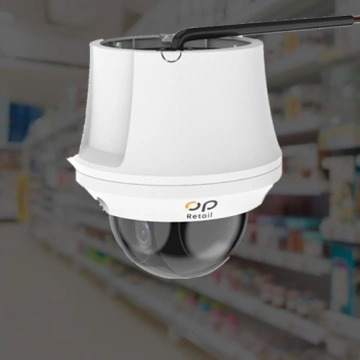
The HD high-speed dome camera offers 4-megapixel resolution, a 4.8–110 mm lens, 23x optical zoom, and 360° panoramic view. Its coverage is approximately 100–150 square meters, with scheduled image capture for wide-area surveillance.
Large or Open Store Areas
A PTZ camera can be considered for spaces where several points need periodic observation, such as larger sales floors or open retail areas. Zoom can also be useful when an operator needs a closer view of a distant display or activity.
However, flexibility does not remove the need for planning. Preset viewing positions, inspection schedules, and priority areas should be defined so operators know which locations require attention.
How Should Existing Camera Infrastructure Affect the Choice?
The camera decision should also consider what the retailer already has in place. Replacing every existing device may not be necessary when the current infrastructure can be connected to a suitable recorder and software environment.
The NVR solution supports existing cameras and allows network devices to be added through the Open Network Video Interface Forum (ONVIF) protocol. It also supports Real Time Streaming Protocol (RTSP), while the AI NVR is described as supporting up to eight high-definition full-motion video streams.
This approach can be useful for projects where a retailer wants to extend inspection or analytics capabilities while retaining compatible surveillance equipment.
What Role Do Network Video Recorders Play?
Cameras capture the visual information, while network video recorders (NVRs) provide centralized storage and management for network video.
For store inspection, that relationship matters because operators may need both live viewing and historical footage. The NVR page describes storage and playback functions, while the AI NVR can add embedded AI video analysis to existing cameras. People counting and behavior-analysis applications are also listed among its supported uses.
The recorder should therefore be evaluated alongside the camera rather than as a separate purchasing decision. Channel capacity, camera compatibility, recording requirements, and future analytics plans all belong in the same system discussion.
A Balanced Selection Approach From OVOPARK
OVOPARK provides several store inspection device types, including fixed turret cameras, high-speed dome cameras, intelligent cameras, and AI inspection solutions. Its store inspection offering combines cameras with software for remote monitoring, AI-powered inspection, traceability, and scheduled image capture.
For a retailer, the appropriate configuration depends on the physical area, inspection frequency, required viewing flexibility, existing equipment, and expected expansion. A fixed camera may suit a defined aisle, while a PTZ-style high-speed dome can be considered for broader areas requiring multiple viewpoints.
Putting Camera Choice Into the Store Inspection Plan
There is no single camera arrangement that fits every retail environment. Fixed cameras emphasize stable observation of defined zones, while PTZ cameras provide greater movement and zoom flexibility for larger or changing viewing requirements.
Retailers evaluating network video recorders should also consider how cameras, recording, remote access, and future AI functions will work together. With the right combination of camera type and recording infrastructure, store inspection can be organized consistently across individual locations and larger retail networks.
For businesses considering a retail surveillance camera system, starting with the inspection objective and store layout provides a practical foundation for equipment selection. The result can be a more coherent setup for monitoring daily conditions, reviewing footage, and supporting standardized store management.