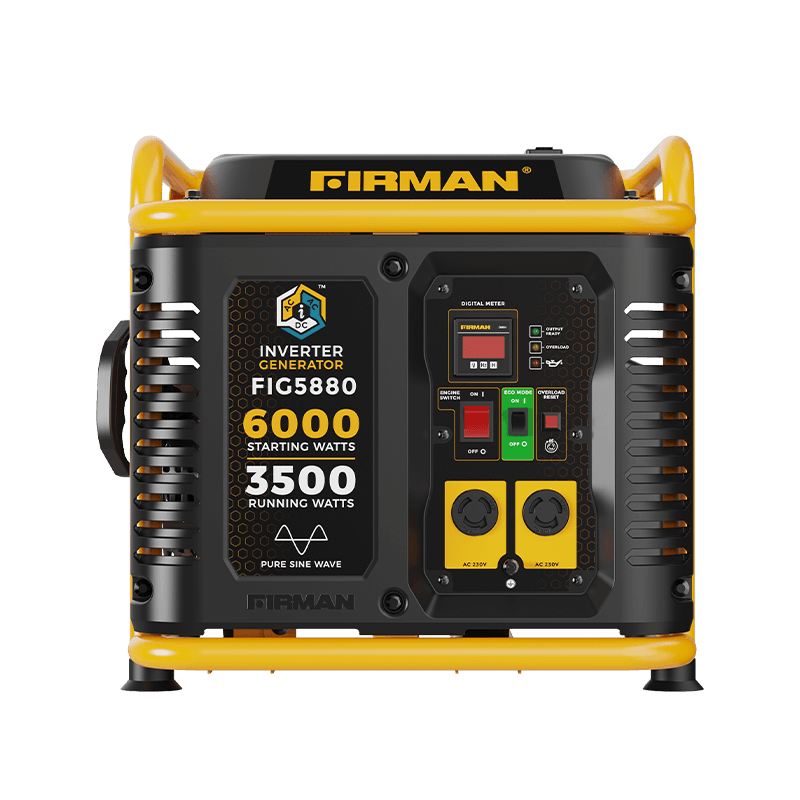
Choosing a portable home backup generator requires more than comparing wattage and purchase price. For residential projects, property managers, retailers, and professional buyers, the right equipment must balance output, fuel efficiency, operating noise, power quality, and practical portability. FIRMAN’s generator portfolio covers multiple power categories, including petrol generators, dieseil genrators, multi-fuel generators, inverter models, renewable-energy products, and power solutions.
Match Generator Output With Household Power Requirements
The first consideration is usable power capacity. A buyer should distinguish between starting watts and running watts because appliances with motors or compressors can require substantially more power when switched on. Air conditioners, refrigerators, pumps, and similar equipment may need sufficient starting capacity even when their normal operating demand is lower.
FIRMAN lists the FIG5880 as a gasoline generator with a starting power of 6,000W and a continuous running power of 3,500W. This allows it to handle the surge power required by inductive loads such as household air conditioners during startup, while delivering greater fuel efficiency and higher performance during prolonged operation.
Why Fuel Efficiency Matters in a Petrol Generator
Fuel consumption directly affects operating costs, particularly when a backup generator may need to operate for extended periods during power interruptions. A fuel-efficient petrol generator can reduce refueling frequency while helping buyers manage the total cost of ownership.
The FIG5880 uses FIRMAN’s ECO FUELER technology. The system can reduce fuel consumption by up to 17% compared with standard generators and 8%–20% compared with other inverter generators on the market. Its ECO mode automatically adjusts engine speed according to demand to optimize fuel use and runtime.
For business buyers sourcing equipment for residential projects, this feature can be particularly relevant when evaluating generators according to operating efficiency rather than purchase price alone.
Low Noise Is Essential for Residential Backup
Noise is another major purchasing factor because a generator intended for home backup may operate close to living spaces. Excessive sound can affect occupants, neighbors, and properties in areas where quiet operation is important.
FIRMAN describes the FIG5880’s NIGHT WHISPER feature as producing a noise level of 64dB(A) at 7 meters under 25% load. This makes noise performance an important specification to consider when selecting equipment for residential applications, camping, and other outdoor uses.
Buyers should always compare noise measurements using the same testing conditions. A decibel figure without its measurement distance or load condition may not provide a meaningful comparison between different generator models.
Clean Power for Sensitive Electronics
Modern homes contain equipment that can be more sensitive to power fluctuations than conventional resistive loads. Computers, communication equipment, smartphones, and certain medical devices require stable electrical power, so power quality should be evaluated alongside generator capacity.
The FIG5880 incorporates FIRMAN’s THD PURIFIER feature, with total harmonic distortion below 1.5%. Low THD can help provide cleaner electrical output for sensitive electronic equipment (e.g. laptops and phones), and is therefore a useful specification for professional buyers assessing a portable home backup generator.
This consideration is especially important for business purchasing teams supplying backup equipment to homes where digital devices and electronic systems represent a significant portion of the electrical load.
Check Surge Capability for High-Demand Appliances
A generator’s ability to handle demanding loads should also be considered before purchase. Air conditioners and other motor-driven appliances can create higher startup requirements than their normal running power suggests. Insufficient surge capability may lead to unstable operation or prevent an appliance from starting.
The FIG5880 features FIRMAN’s AC BOOSTER technology, which is designed to provide over 50% more power output for high-demand appliances such as air conditioners and sensitive electrical equipment. This makes surge performance a relevant evaluation point for buyers whose customers expect backup power to support larger residential loads.
Portability and Application Flexibility
A portable generator should be practical to move, position, store, and deploy when required. Buyers should therefore consider not only electrical performance but also whether the product fits the intended installation and usage environment.
FIRMAN’s wider petrol generator range includes different formats and output classes. For example, the SPG3000 provides 2.8kW starting watts and 2.5kW running watts, while the SPG8000E2 provides 5.5kW starting watts and 5.0kW running watts. These different capacities demonstrate why buyers should select models according to actual load requirements rather than generator size alone.
Evaluate the Supplier and Product Ecosystem
For business buyers, product specifications are only one part of the purchasing decision. Supplier capability, technical support, quality control, and after-sales service can influence long-term project performance.
FIRMAN states that it maintains a quality-control and risk-management system covering manufacturing, while its brand information highlights multi-step quality inspections and continuous product testing. The company also provides service centers and support resources for its products.
Making a More Informed Backup Power Decision
A suitable portable home backup generator should combine adequate starting and running capacity with efficient fuel consumption, manageable noise, clean electrical output, and sufficient surge performance. For professional buyers, these specifications should be assessed alongside portability, application requirements, supplier support, and long-term operating considerations.
The FIRMAN FIG5880 combines 6,000W starting watts and 3,500W running watts with features designed for fuel efficiency, low noise, power quality, and higher-demand loads. For buyers comparing residential backup solutions, evaluating these practical features can lead to a more reliable and application-focused purchasing decision.