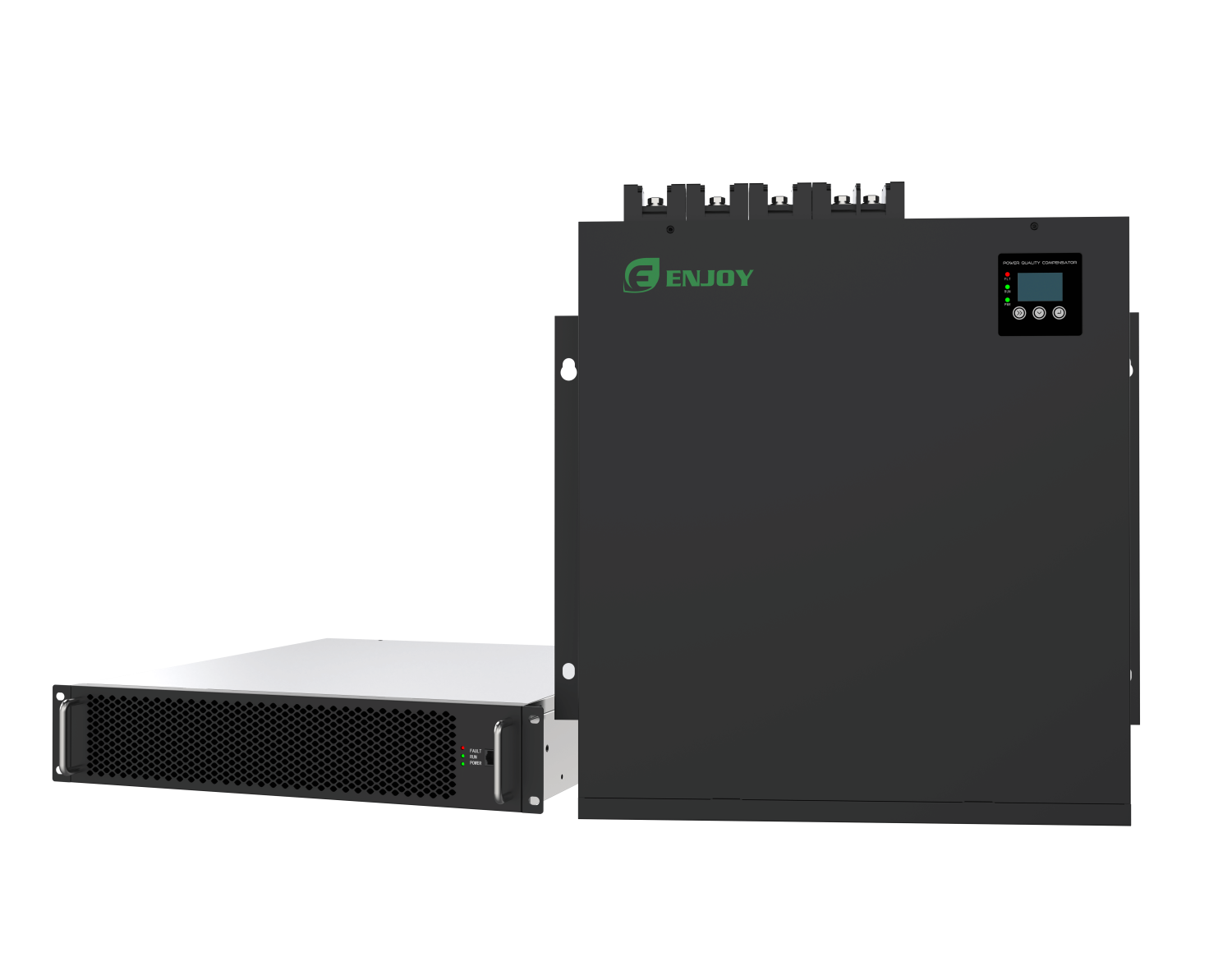
Rapid operational shifts across modern industrial facilities routinely trigger transient voltage sags and phase lagging, destabilizing internal power distribution networks. Implementing high-performance industrial power quality equipment enables plant managers to inject or absorb reactive currents within milliseconds, preventing utility non-compliance penalties and thermal stress on upstream distribution transformers. Comprehensive grid monitoring ensures that inductive loads receive instantaneous var compensation, stabilizing the primary busbar under variable duty cycles.
Focusing on high-reliability power electronics, Enjoypowers engineers advanced power conditioning solutions tailored to complex industrial operating environments. Driven by robust in-house R&D capabilities, flexible hardware customization options, verified equipment stability, and comprehensive global service support, the organization assists engineering teams with custom integration requirements. Technical consultants and plant operators are invited to submit inquiries to receive detailed technical advice and customized product proposals.
Mechanics of Static Var Generator Operation and Dynamic Current Inversion
Static Var Generators operate as self-commutated power conversion systems that synthesize controlled AC voltage vectors through high-frequency switching semiconductors. By regulating internal inverter output voltage relative to grid voltage, the device generates leading or lagging reactive current dynamically without requiring large passive capacitor arrays or heavy reactors.
Unlike traditional switched capacitor banks that deliver fixed var steps, electronic var generators adjust reactive current outputs continuously and steplessly. This instantaneous vector adjustment prevents over-compensation and eliminates transient voltage spikes during heavy motor energization.
Advanced Semiconductor Platforms for High-Performance Power Quality
Modern performance-critical industrial installations benefit significantly from silicon carbide (SiC) semiconductor switching platforms in active conditioning systems. Deploying the SinL Pro Series active filter platform provides a 5 ms response time—twice as fast as legacy IGBT topologies—while achieving 50% lower switching losses across 17 total SKUs spanning 200 Vac, 400 Vac, and 480 Vac systems.
Reduced internal switching losses translate into lower operational cooling demands and higher power density within compact electrical cabinet footprints. Furthermore, SiC-based architectures handle high-order harmonic cancellation up to the 50th order, maintaining clean sinusoidal waveforms across sensitive facility sub-circuits.
Comparing Static Var Generators and Traditional Passive Capacitor Banks
Legacy passive capacitor installations suffer from fixed compensation steps, slow mechanical contactor response times, and potential harmonic resonance hazards. Conversely, electronic var generators act as controlled current sources, avoiding dangerous resonance interactions with grid inductances.
Evaluating modern power factor correction equipment reveals that active static var generation maintains full rated reactive current output even during severe utility voltage sags. This capability prevents voltage collapse across weak facility buses where traditional passive capacitors lose reactive capacity proportionally to the square of voltage drop.
Active Phase Unbalance Compensation and Neutral Current Suppression
Unequal single-phase load distribution across three-phase industrial feeders induces severe voltage unbalance and high neutral line currents. Advanced static var generators redistribute active and reactive power components dynamically between individual phases to restore balanced three-phase voltage profiles.
Mitigating phase current unbalance lowers transformer operating temperatures and prevents neutral conductor overcurrent hazards. Industrial plants protect downstream automated equipment from phase-voltage-imbalance tripping during unequal phase load operations.
Mitigating Dynamic Voltage Fluctuations and Industrial Arc Furnace Flicker
Heavy industrial loads such as electric arc furnaces, spot welders, and large motor drives introduce severe voltage flicker that degrades local power quality. Utilizing SiC-based systems like the SinL Pro Series active filter platform enables ultra-fast var injection within a 5 ms window, suppressing rapid voltage fluctuations before flicker affects adjacent facility sub-systems.
Instantaneous reactive power injection stabilizes busbar voltage during sudden peak load steps. Suppressing line flicker protects sensitive control electronics from voltage-sag reboot cycles.
Integrating Active Harmonic Attenuation with Reactive Var Control
Modern industrial facilities often encounter simultaneous harmonic distortion and low power factor issues caused by non-linear variable speed drives. Incorporating dynamic harmonic filtering into static var generators enables unified active power conditioning within a single cabinet enclosure.
Targeting harmonic current cancellation up to the 50th order restores clean voltage sinusoids without requiring separate passive filter assemblies. Combining harmonic suppression with reactive compensation optimizes capital investment and lowers site footprint requirements.
Selection Criteria for Industrial Facility Deployments
Selecting appropriate industrial power quality equipment requires evaluating site voltage classes, dynamic response speed requirements, physical enclosure constraints, and thermal dissipation capacities. Engineering teams analyze total harmonic current distortion parameters alongside reactive power demand curves to size compensation modules accurately.
Choosing high-power-density hardware optimizes space utilization inside crowded switchgear rooms. Modular rack-mount or wall-mount form factors allow facilities to expand conditioning capacity incrementally as operational loads grow.
Digital System Integration and Management Communication
Industrial power quality systems can integrate with facility monitoring and control systems through communication interfaces such as RS485. Real-time digital telemetry provides facility managers with accurate visibility into voltage vectors, current harmonics, and reactive power exchange.
Continuous telemetry logging facilitates predictive maintenance and simplifies compliance reporting for utility grid operators. Real-time status monitoring supports high operational availability across multi-site industrial operations.
Evaluating Long-Term Economic Value and OpEx Reductions
Financial assessments for dynamic var compensation installations show measurable reductions in monthly utility bills through improved power factor and potentially reduced low-power-factor charges, depending on the applicable utility tariff structure. Operating active compensation hardware from a qualified power factor correction equipment provider reduces upstream line losses and frees up electrical capacity on site distribution transformers.
Lower operational expenditures resulting from reduced switching losses and diminished cooling requirements accelerate asset payback schedules. Investing in robust var compensation infrastructure protects sensitive facility machinery, extending overall equipment lifespan.
Conclusion
Deploying advanced Static Var Generators enables industrial facilities to maintain stable voltage profiles, suppress harmonic pollution, and optimize power factor performance under dynamic load conditions. Utilizing hardware technologies from Enjoypowers provides resilient, industrial-grade power conditioning backed by internal R&D, flexible product customization, tested system stability, and responsive global service support. Engineering teams, project developers, and facility managers are invited to contact technical specialists to obtain tailored product specifications and discuss specific project requirements.