Compact enclosures are becoming increasingly common across industrial controls, electrical equipment, automated systems, and specialized appliances. As available installation space becomes tighter, thermal management becomes more demanding. Heat must be distributed efficiently without creating unnecessary temperature fluctuations or consuming excessive electrical power. For equipment designers, the challenge is therefore not simply choosing a heater with sufficient output, but finding a compact heating architecture that combines airflow, temperature regulation, safety, and dependable long-term operation.
Why Compact Enclosures Need Better Thermal Management
A compact enclosure can contain electronic components, wiring, control systems, sensors, or mechanical parts within a relatively small volume. When heating is required, the limited internal space can make temperature distribution more difficult. A conventional heating element may generate localized heat without moving warm air effectively throughout the enclosure.
Fan-assisted heating addresses part of this challenge by combining a heating element with forced airflow. The fan moves air across the heating surface and distributes the resulting warm air into the surrounding space. This approach can help reduce temperature differences within the enclosure and accelerate the heating process when compared with relying only on natural convection.
For equipment manufacturers, compact construction also makes component selection important. The heater needs to fit the available space while leaving sufficient room for airflow, wiring, mounting, and maintenance. A smaller heating assembly can therefore provide greater flexibility during equipment design.
How PTC Technology Improves Heating Efficiency
PTC stands for positive temperature coefficient, referring to a material characteristic in which electrical resistance increases as temperature rises. PTC ceramic heating elements use this characteristic to regulate their electrical behavior. As the element heats up, resistance increases and current flow is reduced, which naturally limits power output.
This self-regulating behavior is one reason PTC technology is attractive for thermal management. Instead of maintaining the same electrical response throughout the heating cycle, the element changes its resistance as its temperature changes. The result can be more controlled heating and reduced unnecessary power consumption once the element becomes hotter.
For compact equipment, this characteristic can also simplify the thermal design. Engineers can combine PTC heating with airflow to create a heating module that responds naturally to changing thermal conditions rather than depending entirely on a fixed-output heating element.
What to Look for in a PTC Fan Heater Manufacturer
Selecting a PTC fan heater manufacturer involves more than comparing nominal wattage. Equipment developers should first examine whether the supplier can provide configurations compatible with the enclosure’s electrical and mechanical requirements.
Voltage and power ranges are fundamental considerations. The heater must match the equipment’s power architecture, while its output should correspond to the required heating load. Physical dimensions are equally important because even a technically suitable heater may be difficult to integrate into a compact enclosure if its housing or mounting arrangement does not fit.
Airflow should also be evaluated. A fan-integrated module can move heated air directly into the enclosure, but the airflow path must work with the enclosure’s internal geometry. Designers should consider inlet and outlet positions, obstructions, ventilation openings, and the location of heat-sensitive components.
Safety and Reliability in Continuous Operation
Industrial heating components may operate for extended periods, making safety and durability central purchasing considerations. PTC technology offers a useful characteristic because resistance rises as temperature increases, helping limit the heater’s power output as it becomes hotter. This self-regulating principle is widely associated with safer and more controlled heating.
Insulation is another important consideration, particularly when the heating module is installed near electrical components or within an enclosed system. An insulated construction can help separate electrically active heating components from surrounding structures while supporting safer equipment integration.
For business buyers, service life should be considered alongside thermal performance. A durable heating module can reduce the frequency of component replacement and maintenance interventions. This matters particularly for equipment deployed in commercial or industrial environments where service access may be limited.
Why Fan Integration Matters for Enclosure Heating
A separate heating element and fan can require additional engineering work, wiring, mounting space, and assembly steps. Integrating the two functions into one module can simplify the overall thermal architecture.
The fan creates forced airflow across the PTC heating element, helping transfer heat away from the ceramic surface and into the target space. This makes the configuration suitable for applications where warm-air circulation is more useful than direct-contact heating.
Compact fan heater modules can therefore be considered for equipment such as enclosed control systems, cabinets, disinfection equipment, and other devices requiring localized space warming. The final configuration should always be selected according to the enclosure volume, required temperature range, airflow conditions, and electrical specifications.
Engineering Considerations Before Procurement
Before purchasing a heating module, equipment manufacturers should define the application’s actual requirements. Important parameters include available voltage, required heating power, enclosure dimensions, expected operating duration, airflow direction, ambient conditions, and mounting limitations.
Testing is also valuable during product development. A heater that performs well under laboratory conditions may behave differently once installed inside a restricted enclosure. Prototype testing can reveal airflow bottlenecks, uneven temperature distribution, or interference with nearby components before mass production begins.
Suppliers that support customization can be especially useful for OEM projects. Adjustments to electrical specifications, physical dimensions, mounting structures, or other design parameters may allow the heating solution to fit the equipment rather than forcing the equipment to accommodate a standard component.
A Compact Option for Integrated Heating
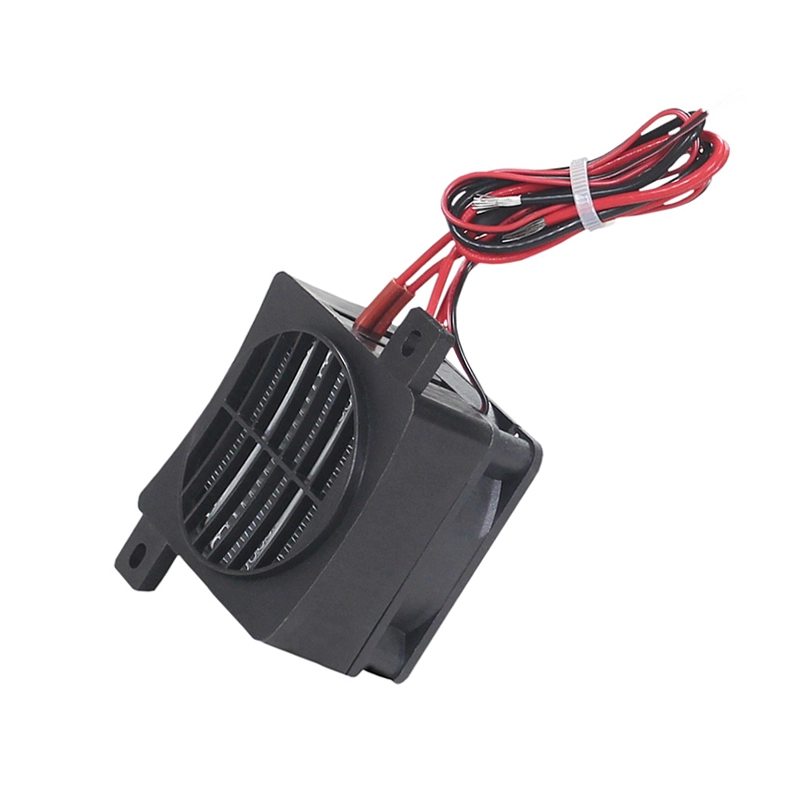
For manufacturers seeking a compact fan-assisted heating configuration, one insulated PTC fan heater module is specified for 50–200W output and 12–220V voltage. Its construction combines a built-in fan, front grille outlet, side mounting bracket, and PTC ceramic heating element within a compact black plastic housing.
The specified module uses a nylon shell and an insulated surface without an open flame or visible red-hot heating element. High-temperature wires are used, and the stated continuous operating capability exceeds 5,000 hours. The specification also identifies good moisture resistance and stable performance, while its compact design is intended for fast space warming.
Moving Toward Smarter Compact Heating
For OEM and industrial equipment developers, PTCYIDU provides PTC heating solutions designed around different equipment requirements. The company offers insulated and conductive PTC air heaters, fan heaters, aluminum shell heaters, flexible PTC heaters, other heater configurations, and accessories, with custom voltage, wattage, dimensions, and mounting options available for OEM integration.
Its insulated PTC fan heater module is specified at 50–200W and 12–220V, combining a fan-integrated structure with an insulated surface and PTC ceramic element. For compact enclosures requiring fast warm-air circulation, this type of integrated design can offer a practical balance of space efficiency, thermal control, and operational reliability.