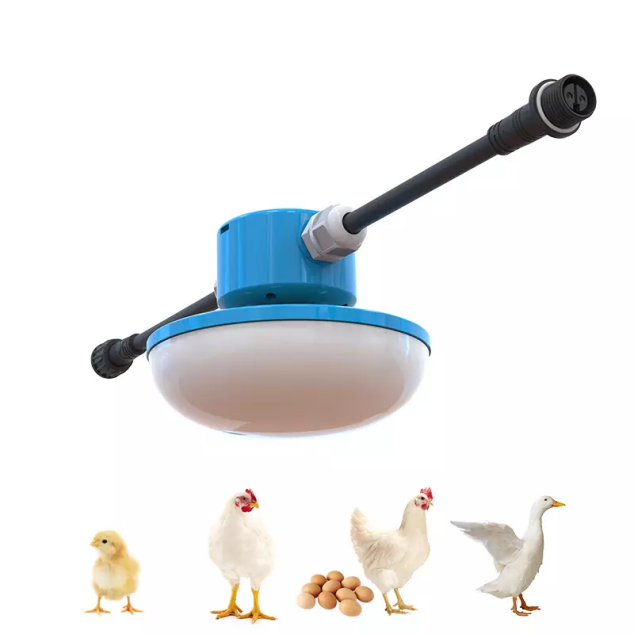
For modern commercial poultry operations, the question of “What type of bulb for a chicken coop?” has evolved beyond simple illumination. It is now a complex calculation rooted in animal science, energy efficiency, and return on investment (ROI). The answer is not a standard hardware store product, but a highly engineered, application-specific poultry house led bulbs system designed to regulate bird physiology and maximize production metrics.
Choosing the wrong lighting solution can directly lead to higher stress levels, reduced feed conversion rates, and decreased egg yield. This guide explores the non-negotiable requirements for professional poultry lighting, focusing on the three critical factors that drive performance in contemporary farm environments.
The Shift to Specialized Poultry House LED Bulbs
Traditional incandescent and fluorescent lights are rapidly being replaced by Light Emitting Diode (LED) technology across the agriculture sector. This transition is not merely driven by energy savings, but by the LED’s unparalleled ability to offer precise control over light intensity, spectrum (color), and duration—the three key variables that control a chicken’s biological and behavioral processes.
The benefits of upgrading to professional LED systems include:
- Energy Efficiency: LEDs require up to 80% less energy than outdated incandescent options, resulting in dramatic reductions in operational costs.
- Longevity: Specialized poultry house led bulbs often have lifespans exceeding 50,000 hours, drastically reducing maintenance and replacement cycles in large facilities.
- Biological Control: Only LEDs can reliably deliver the flicker-free, deep dimming, and custom color spectrum necessary for simulating natural day-night cycles and promoting specific physiological responses in birds.
The Three Critical Factors in Professional Poultry Lighting
For commercial producers, optimizing lighting involves managing three variables simultaneously: intensity, spectrum, and photoperiod.
1. Intensity (Lux) and Smooth Dimming
Light intensity, measured in lux (lumens per square meter), must be meticulously controlled throughout the bird’s life cycle:
- Brooding Phase: Chicks require high intensity (up to 30–50 lux) for the first few days to encourage mobility, feed, and water intake.
- Grower/Layer Phase: As birds mature, intensity is typically dimmed to a lower level (5–20 lux) to promote calmness and reduce aggressive behavior, such as feather pecking.
Crucially, poultry lighting systems must be capable of flicker-free, 0-100% smooth dimming. Chickens are highly sensitive to flicker (detecting rates up to 200 Hz, far exceeding human perception), and flickering lights cause chronic stress. Smooth dimming simulates a natural sunrise and sunset, which regulates the bird’s circadian rhythm, improving overall welfare and flock uniformity.
2. Spectrum (Color Temperature) Management
Chickens are tetrachromatic, meaning they see colors and light wavelengths that are invisible to humans. Utilizing the correct light spectrum is vital for meeting specific production goals:
| Application | Optimal Spectrum | CCT Range (Kelvin) | Physiological Benefit |
| Broilers/Pullets | Blue and Green Enhanced Light | 4000K–5000K (Cool White) | Calms birds, reduces aggression, and accelerates growth and muscle development. |
| Layers/Breeders | Red and Orange Enhanced Light | 2700K–3000K (Warm White) | Stimulates the pituitary gland (deep brain photoreceptors), enhancing gonadotropin secretion to accelerate sexual maturity and increase egg production. |
Modern specialized systems allow farmers to dynamically change the light color to match the flock’s phase (e.g., cool white for growth, transitioning to red-enriched warm white for peak lay).
3. Photoperiod (Duration)
The daily duration of light exposure impacts growth and reproduction. For laying hens, providing a consistent photoperiod of 14 to 16 hours of light is key to maintaining peak egg production. The seamless dimming function of professional LED systems is used to introduce the “rest” period by creating a gradual transition into darkness, which is far less stressful than a sudden “light off” event.
Durability and Precision for Commercial Poultry LED Bulbs
The environment inside a poultry house is one of the most challenging for electronic equipment. High humidity, airborne particulate matter, and the presence of ammonia necessitate professional-grade durability.
Any professional poultry led bulbs system must meet strict agricultural standards:
- High IP Rating: A rating of IP67 or higher is required to withstand high-pressure, high-temperature washdowns (common practice for barn cleaning).
- Ammonia Resistance: Components must be made from materials (like PC, PMMA, and specialized coatings) that resist corrosion from ammonia gas, which significantly shortens the lifespan of standard lighting fixtures.
- Correct Beam Angle: Unlike household bulbs, professional poultry lights feature directional beam angles (often 120–145 degrees) to focus light down onto the floor, where the birds are, ensuring consistent light distribution and eliminating dark spots that can lead to clustering.
The szAMB BU140C: An Engineered Solution for Bird Care
When scaling production and protecting investment, relying on proven agri-lighting experts is essential. szAMB (Shenzhen AMB Technology Co., Ltd) specializes in robust, high-performance LED systems engineered specifically for livestock and poultry environments since 2006.
The szAMB BU140C Birds Care Lighting, designed for Broiler and Pullet operations, exemplifies the integration of animal science and engineering excellence required for today’s farms.
Precise BU140C Specifications:
The BU140C series is built to maximize bird welfare and operational efficiency:
| Feature | Specification Details | Impact on Production |
| Design & Durability | IP67 Rating; PC/PMMA cover; Ammonia Impact Resistant. | Withstands high-pressure washdowns; ensures long-term reliability in harsh barns. |
| Dimming Technology | 0-100% Smooth Dimming; Flicker-Free function. | Eliminates bird stress and subsequent aggression, leading to improved feed conversion. |
| Efficiency | Luminous Efficiency up to 120 lm/W; Wattage options (e.g., 9W, 15W). | Reduces power consumption dramatically compared to older technology, driving down operational costs. |
| Spectrum Options | Available in adjustable CCT (2700K–6500K) White, Full Spectrum (for broilers), and Red+White combinations (for layers). | Allows farmers to select or switch colors based on the bird’s life stage (growth vs. laying). |
| Power Flexibility | Available in DC48V (compatible with 0-10V dimmers) or AC (110V-220V Triac dimming). | Provides integration flexibility for new and retrofit automated control systems. |
| Warranty & Lifespan | 5 years warranty; >50,000-hour lifespan. | Guarantees reliability and long-term ROI certainty. |
The BU140C’s unique design provides optimal uniform lighting distribution, which is key to preventing bird clustering and ensuring every bird has equitable access to feed and water, thereby enhancing flock uniformity and overall weight gain.
In conclusion, the best poultry house led bulbs are those specifically rated for agriculture, offering precise spectral control, deep dimming, and superior durability. For commercial producers, investing in engineered lighting solutions like the szAMB BU140C is not a maintenance cost—it is a strategic investment that directly contributes to better animal welfare, improved production results, and a lower environmental footprint.