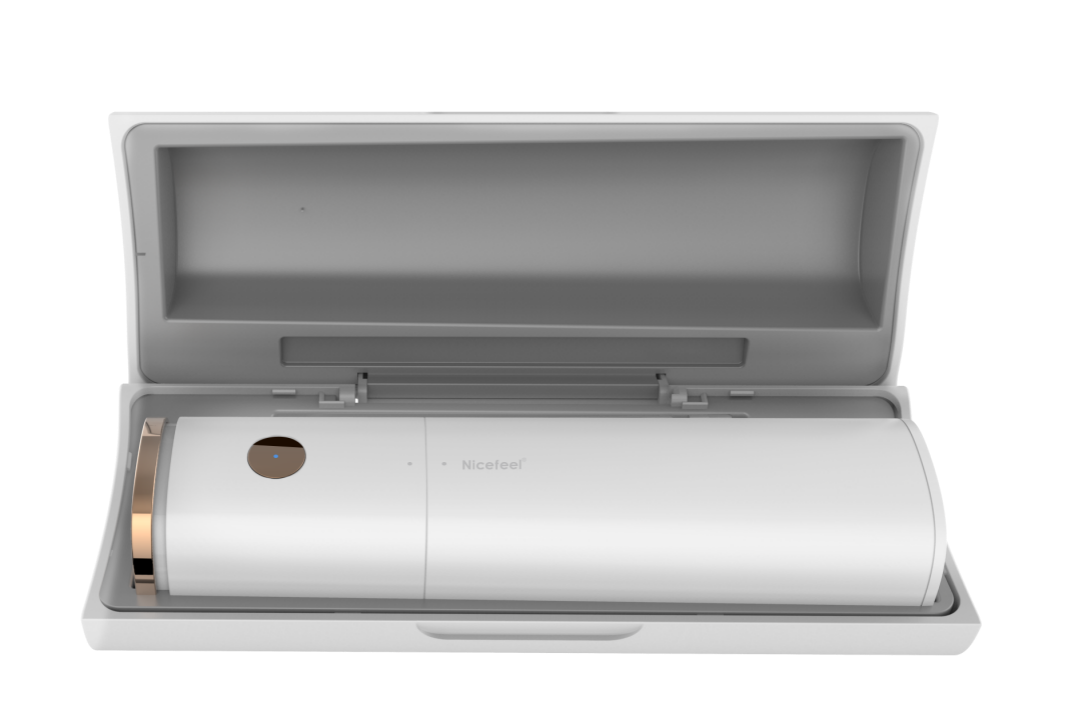
Travel changes the way people evaluate oral-care devices. At home, a large reservoir and countertop footprint may be acceptable, but luggage space, charging access, and weight become more important on the road. A portable irrigator should therefore balance three practical factors: physical size, battery capability, and water capacity.
The American Dental Association identifies water flossers as powered interdental cleaners that can help remove food debris and plaque from between teeth and along the gumline. For travelers, choosing an electric dental flosser is less about maximizing every specification and more about finding a combination that supports regular use without creating unnecessary packing or charging problems.
Start With the Overall Size
The first specification to compare is physical size. Check the complete dimensions rather than judging a device only by its appearance. A slightly longer body may accommodate a useful reservoir, while a broader body may provide a more stable grip.
Weight matters just as much for frequent travelers. A handheld water flosser may spend more time in a toiletry bag than on a bathroom counter, so every additional gram can affect portability. A balanced body can also be easier to handle.
Balance Tank Capacity With Portability
Water capacity creates one of the clearest travel trade-offs. A large reservoir reduces refilling, but it usually requires more internal space. A smaller tank can make a device easier to pack, although users may need to refill it more often during a session.
There is no single ideal tank size for every traveler. Someone taking short business trips may prioritize a smaller body, while a family traveler may value additional capacity. When comparing a handheld water flosser, look at tank capacity alongside dimensions and weight rather than assuming that the biggest tank is automatically the most convenient.
Evaluate Battery Capacity, Not Just Numbers
Cordless operation removes the need to find a convenient outlet beside the sink, which can be especially useful in hotels. Battery capacity is therefore important, but milliamp-hours alone do not tell the complete story. Motor behavior, selected pressure, operating mode, and session length can all affect actual usage between charges.
Charging time should be checked alongside battery capacity. A model with a large battery can still be inconvenient for travel if it takes too long to recharge. Buyers should also review the charging interface and stated input requirements before taking an electric dental flosser abroad.
Consider Pressure and Cleaning Modes
Travel-friendly design should not come at the expense of usable cleaning controls. Different users may prefer different water pressures, so adjustable settings can make a portable device more adaptable. Multiple modes can also provide options for users who want standard or gentler operation.
Travelers should follow the manufacturer’s instructions and select settings that feel comfortable. For product buyers, pressure range and mode selection should be evaluated together with size, battery, and reservoir capacity.
Waterproofing Adds Practical Value
Water and electricity require careful product design, especially when a device is used beside a sink. A stated waterproof rating gives buyers a defined specification to compare, but it should always be interpreted according to the manufacturer’s instructions.
IPX7 appears on several current portable models in the product range. Checking the full user instructions remains important for safe cleaning, storage, and charging.
Flycat’s Travel-Oriented Configurations
Flycat offers several portable models with different balances between reservoir size and battery capacity. Their official portable category includes options from 77mL to 200mL reservoirs, while the handheld range also includes larger 280mL and 300mL configurations. This variety lets buyers compare portability priorities.
Their FC3880 is listed with a 77±10mL water tank, an 800mAh 3.7V battery, approximately two hours of charging time, and a 30–70 PSI pressure range. By comparison, the FC5130 has an 180mL tank, a 1500mAh battery, about three hours of charging time, and a 60–120 PSI pressure range.
Comparing Flycat Models for Travel
Flycat’s FC5600 provides another reference point for buyers considering a larger portable format. The official specification lists dimensions of 84.9 × 72 × 219.2mm, approximately 244g net weight, a 300mL water tank, three cleaning modes, a 1400mAh battery, and IPX7 waterproofing.
Their FC5570 is approximately 241g and also uses a 300mL tank, but it has a 1200mAh battery and a listed charging time of no more than four hours. It provides high, low, and pulse modes with a 21–115 PSI impact range.
Final Buying Checklist
When selecting a travel handheld water flosser, start with dimensions and weight, then evaluate water capacity and battery specifications together. After that, review pressure range, operating modes, charging time, waterproof rating, and accessory configuration. This approach avoids choosing a product based on one attractive number while overlooking everyday usability.
Flycat‘s range gives B2B buyers multiple configurations, from smaller tanks designed around portability to larger-capacity handheld formats. Their official handheld category also highlights OEM/ODM services and scalable manufacturing capabilities, which may be relevant for brands developing private-label oral-care products.
For travel-focused positioning, the most suitable electric dental flosser is the one whose size, battery, and reservoir are balanced for the intended user. Reviewing these specifications together can make product selection more systematic and help businesses communicate meaningful benefits rather than relying on generic portability claims.