Choosing among 3D metal printers is not simply a matter of comparing machine prices or maximum build dimensions. For manufacturers, engineering companies, research institutions, and other professional buyers, the more important question is whether a supplier can provide a stable printing process, suitable equipment, technical support, and a practical path toward production. The manufacturer behind the machine can therefore be as important as the machine itself.
Start With the Manufacturer’s Metal AM Experience
A supplier’s technical background is one of the first factors worth examining. Metal powder bed fusion requires coordinated control of powder handling, scanning, motion, airflow, process parameters, and software. LiMN 3D states that its parent company, LINMU Laser, has 24 years of laser-industry experience and provides SLM metal additive manufacturing equipment for global users. Its stated application areas include aerospace, automotive, medical and dental manufacturing, mold making, consumer electronics, energy, and research.
For business buyers, this type of background matters because a metal printer is rarely purchased as an isolated piece of equipment. The supplier’s engineering knowledge can influence installation, process development, troubleshooting, and future production expansion.
Compare Printing Technology and Process Control
The next comparison should focus on how the machine forms metal parts. Buyers should determine whether the manufacturer’s technology matches their materials, part geometries, production volume, and quality requirements.
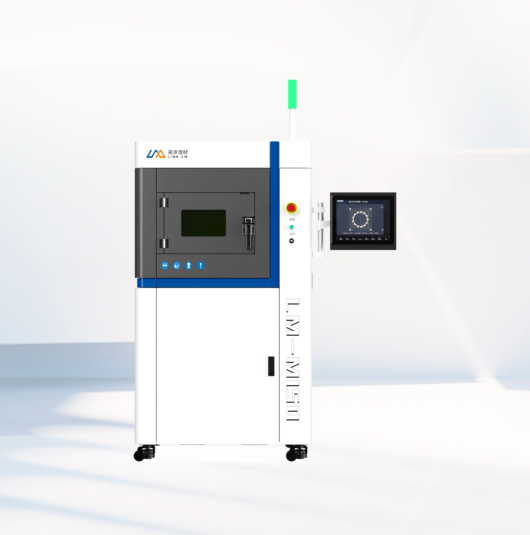
The LiMN 3D LM-M150 adopts metal powder bed melting technology. Its official specifications list a 20–120 μm layer thickness range, allowing the system to be configured for different build requirements. The machine dimensions are 960 × 730 × 1788 mm, with listed power consumption of 380 V, 34 kW.
Process stability deserves equal attention. The LM-M150 is described with an airflow system designed to provide a uniform wind field and clean surfaces, while an independent circulation filtration system is intended to reduce filter replacement frequency. These details are relevant when buyers are evaluating repeatability and operational maintenance rather than only headline specifications.
Motion control is another useful comparison point. The LM-M150 uses servo-driven scanning and powder spreading, while its Z-axis incorporates a high-precision grating ruler with stated 0.01 mm repeatability. A proprietary correction algorithm is also specified for printing accuracy.
Examine Software and Workflow Compatibility
A 3D printer that prints metal must fit into the customer’s broader digital manufacturing workflow. Software should therefore be evaluated alongside hardware.
The LM-M150 uses the TH3D control system, which LiMN 3D describes as covering the control process from data processing through forming. For production teams, centralized control can simplify operation and reduce the number of separate systems operators need to manage.
Buyers should also ask what technical support is available for data preparation, parameter development, operator training, installation, and maintenance. LiMN 3D lists 3D printing services, prototype development, training and support, installation and maintenance, and FAQs as part of its support offering.
This is particularly important for companies moving from prototyping toward repeat production. Operator qualification is also recognized by ASTM through ISO/ASTM 52926-2, which addresses qualification principles for operators working with laser-based metal powder bed fusion.
Compare the Product Range, Not Just One Machine
A manufacturer’s wider product portfolio can reveal whether it can support future capacity requirements. LiMN 3D currently lists models including the LM-M100D Lite, LM-M120D Lite, LM-M150, LM-M280, LM-M400, and LM-M800. The machines cover different physical dimensions and electrical requirements, while several industrial models specify a 20–120 μm layer thickness range.
This range can be useful for businesses whose requirements may change over time. A company could begin with a smaller system for development and validation, then consider larger equipment as production volumes increase. The key is to confirm whether the supplier’s equipment roadmap corresponds with the buyer’s expected production growth.
Assess Application Knowledge and Long-Term Support
Finally, buyers should evaluate whether the manufacturer understands their industry rather than simply selling general-purpose equipment. Application experience can influence recommendations for part design, process parameters, materials, and production strategy.
LiMN 3D identifies applications ranging from dental and medical products to heat exchangers, molds, aerospace components, automotive parts, electronics, and shoe molds. Its website also presents examples including acetabular cups, heat sinks, impellers, automotive brakes, aerospace bearings, and complex mold structures.
Making the Manufacturer Comparison More Practical
For business purchasers, comparing 3D metal printers should involve more than price, speed, or build size. Technology, process control, machine specifications, software, application expertise, product range, and after-sales support all affect the long-term value of the investment.
LiMN 3D provides a relevant example through its LM-M150, combining metal powder bed melting technology, a 20–120 μm layer thickness range, precision motion control, filtration and airflow systems, and TH3D control.
A structured evaluation of these factors can help engineering and procurement teams identify a manufacturer whose equipment is not only technically suitable today but also capable of supporting a reliable metal additive manufacturing workflow as production requirements develop.