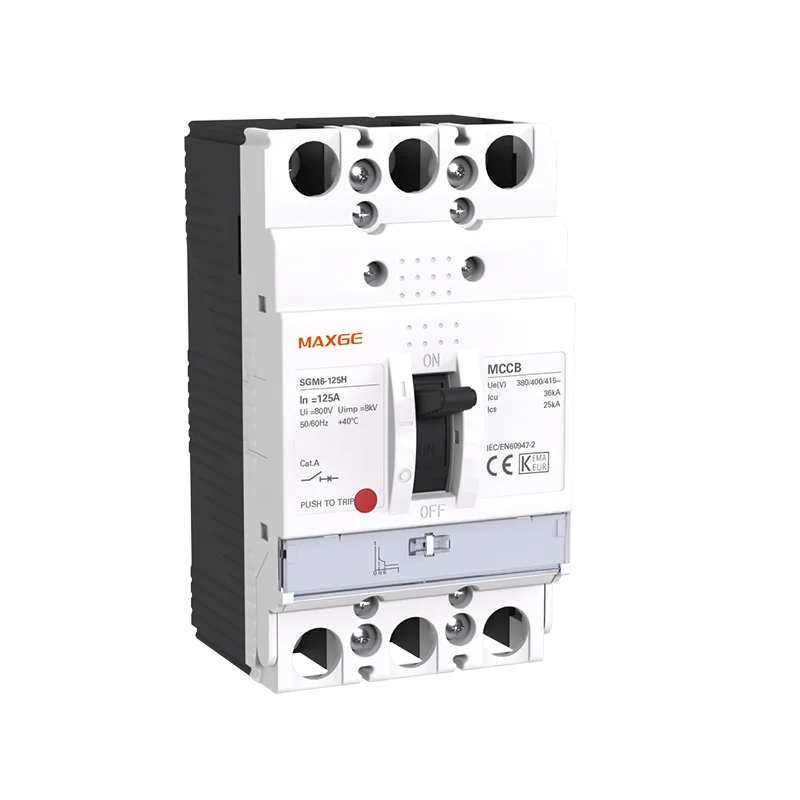
When selecting circuit protection for an electrical distribution system, current rating is often the first specification engineers review. However, it is only part of the picture. A breaker may be suitable for the normal operating current and still be inappropriate if its ability to interrupt a fault is insufficient.
This is where MCCB breaking capacity becomes critical. Expressed in kiloamperes (kA), breaking capacity indicates how much fault current a circuit breaker can safely interrupt under specified conditions. Understanding this specification, together with MCCB ratings, helps ensure that electrical control products are matched to the actual requirements of an installation.
What Does MCCB Breaking Capacity Mean?
Breaking capacity refers to the maximum prospective short circuit current that a circuit breaker can interrupt safely at its specified voltage and operating conditions. For an MCCB, this value is commonly expressed in kA.
During a short circuit, the fault current can rise far above the normal operating current. The circuit breaker must open the circuit and extinguish the resulting arc without suffering unacceptable damage or allowing the fault to continue.
For example, an MCCB with a 25 kA breaking capacity should not be selected for an installation where the prospective short circuit current exceeds that value under the applicable test and installation conditions. The correct selection requires comparing the breaker specification with the calculated fault level at the installation point.
Breaking Capacity Is Different From Current Rating
One common source of confusion is treating rated current and breaking capacity as the same specification. They serve different purposes.
MCCB ratings describe the current the breaker is designed to carry under specified conditions, while breaking capacity addresses its ability to interrupt fault current. A breaker could have an appropriate rated current for a load but still require a higher breaking capacity because of the available short circuit current in the electrical network.
This distinction becomes particularly important when selecting breakers for industrial facilities, commercial buildings, distribution boards, and other installations with substantial electrical capacity.
Engineers should therefore evaluate both normal load requirements and fault conditions rather than selecting a breaker based solely on its ampere rating.
How to Determine the Appropriate kA Rating
Selecting the appropriate breaking capacity starts with understanding the prospective short circuit current at the point where the MCCB will be installed. This value depends on factors such as the transformer capacity, system impedance, cable characteristics, and upstream electrical equipment.
The breaker’s rated voltage and application conditions must also be considered. A breaking capacity specified at one voltage should not automatically be assumed to apply identically at another voltage.
For this reason, the kA value should be checked against the technical documentation for the specific circuit breaker and the requirements of the electrical installation. When the calculated fault current is close to the breaker’s rated breaking capacity, additional engineering review is especially important.
Why MCCB Ratings Require More Than Ampere Selection
Choosing appropriate MCCB ratings involves several parameters rather than a single number. Rated current, frame size, pole configuration, voltage, breaking capacity, trip characteristics, and installation conditions can all influence the final selection.
For three phase systems, 3-phase MCCB ratings should be evaluated according to the system voltage, load characteristics, and protection requirements. Similarly, when a neutral conductor needs to be switched or protected according to the system design, 4-pole MCCB ratings may need to be considered.
The goal is not simply to select the largest available rating. An oversized breaker may not provide the desired level of overload protection, while an undersized device may trip unnecessarily during normal operation. Proper selection should balance protection performance with actual system demand.
What Happens If Breaking Capacity Is Too Low?
Using an MCCB with insufficient breaking capacity can create a serious protection issue. If a short circuit occurs and the fault current exceeds the breaker’s interrupting capability, the device may not be able to safely clear the fault.
The consequences can include severe equipment damage, extended downtime, and increased risk to the surrounding electrical installation. This is why breaking capacity should be treated as a fundamental safety specification rather than an optional technical detail.
It is also important to consider coordination between the MCCB and upstream or downstream protection devices. A properly designed system should allow the appropriate protective device to respond to a fault while limiting unnecessary disruption to unaffected circuits.
Selecting Electrical Control Products With the Application in Mind
Reliable circuit protection depends on selecting electrical control products according to the complete electrical system rather than isolated specifications. Load current, short circuit levels, voltage, pole configuration, protection characteristics, and installation conditions should all be reviewed before final selection.
MAXGE provides a range of low voltage electrical protection and control products, including moulded case circuit breakers and other circuit protection solutions. Its product portfolio can be reviewed according to different system and application requirements.
For engineers and purchasing teams comparing MCCB options, examining technical specifications and application requirements together can make product selection more precise. The appropriate breaking capacity should always be verified against the calculated fault level and the relevant product documentation.
Building a More Appropriate Protection Strategy
MCCB breaking capacity is an important parameter when evaluating whether a circuit breaker is suitable for a particular electrical system. While rated current relates to the load the breaker is designed to carry under specified conditions, the kA rating indicates its short-circuit interruption capability within the applicable operating conditions.
A more complete selection should consider prospective fault current together with rated current, operating voltage, pole configuration, trip characteristics, and protection coordination. For systems using 3-phase or 4-pole MCCBs, these parameters should be evaluated against the actual distribution configuration rather than considered separately.
MAXGE supports circuit protection selection through a broad low-voltage electrical product portfolio and technical development capabilities. Its R&D resources and testing infrastructure, including CNAS-related laboratory capabilities, support product development and evaluation across different application requirements. Beyond conventional distribution systems, its electrical protection portfolio also covers PV, renewable energy, energy storage, and EV charging applications.
With manufacturing bases in Deqing and Wuhu and a brand portfolio that includes MAXGE, EMA, and GEBLER, the company supports customers across more than 60 countries through over 80 distribution partners. For MCCB breaking capacity, product specifications, or application-related questions, you can contact MAXGE through its official website.