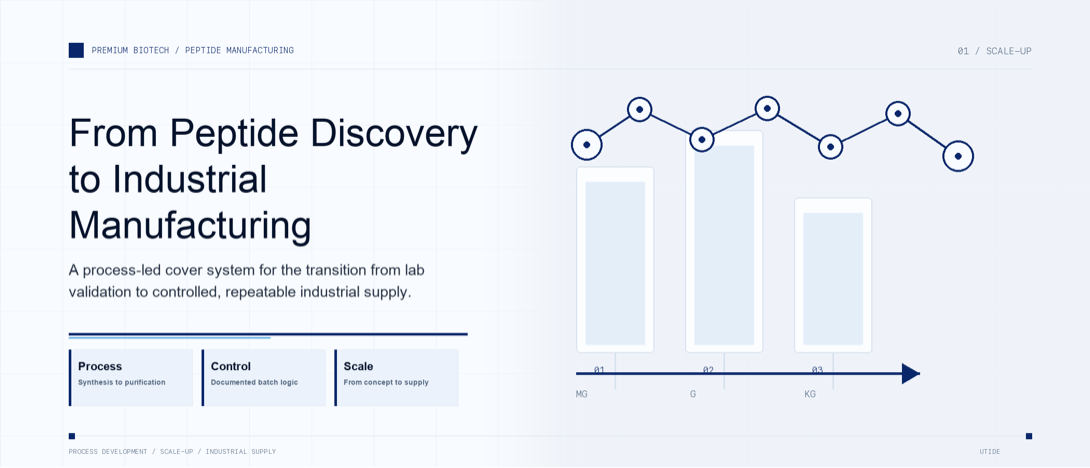
In modern biopharmaceutical development, transitioning a complex peptide candidate from discovery to commercial production represents a multi-faceted engineering challenge. Native linear sequences and intricate modified molecules often encounter severe chemical, structural, and thermodynamic hurdles during volume expansion.
While small research-scale synthesis can tolerate low crude yields or unoptimized reaction profiles, commercial viability depends on high coupling efficiency, minimal side-reaction accumulation, and strict batch-to-batch consistency. As drug development pipelines feature longer sequences, non-canonical amino acids, and lipidated side chains, biopharmaceutical leaders must evaluate how synthetic parameters evolve at industrial volumes.
Understanding the chemical and physical drivers of synthetic scalability enables procurement leaders, supply chain managers, and process development directors to build resilient supply chains for custom peptide manufacturing. Conducting thorough feasibility evaluations early in development reduces operational risk and accelerates the transition from laboratory optimization to multi-kilogram manufacturing.
Key Technical Parameters Defining Scalable Custom Peptide Manufacturing
Achieving synthetic efficiency and commercial viability during scale-up requires systematically optimizing core operational parameters across the entire synthesis and purification workflow:
Reagent Dynamics and Coupling Efficiency: As peptide chain length increases, secondary structure formation and steric hindrance frequently cause incomplete amino acid addition. While excess reagents can force reaction completion at bench scale, doing so during large-scale production dramatically increases operational costs and generates excessive chemical waste. Robust process optimization relies on specialized resin selection, tailored solvent mixtures, and controlled thermal profiles to maintain efficient coupling kinetics without wasteful reagent consumption.
In-Process Quality Controls and Crude Quality: A fundamental goal during initial peptide process development is maximizing crude purity before downstream purification. Accumulation of deletion sequences, diastereomers, and truncated side-products creates severe purification bottlenecks at larger volumes. Implementing real-time analytical monitoring—such as high-performance liquid chromatography and mass spectrometry—during coupling and cleavage steps enables early detection of synthetic inefficiencies, protecting crude quality across multi-kilogram batches.
Preparative Purification and Counter-Ion Control: Downstream purification grows increasingly complex as batch sizes expand. Preparative chromatography methods must achieve strict purity specifications without requiring excessive solvent volumes or causing significant product yield loss. Furthermore, precise counter-ion conversion—replacing residual trifluoroacetate (TFA) salts with biocompatible acetate or chloride forms—is vital for formulation stability and batch uniformity in commercial peptide API manufacturing. Establishing repeatable exchange parameters supports consistent control of final lot specifications across successive production cycles.
Real-World Scale-Up Challenges Across Complex Sequence Classes
The practical importance of synthetic scalability becomes evident when examining demanding peptide classes across therapeutic research domains.
In metabolic and endocrine research, long-acting peptide candidates such as
Eloralintide and Amycretin may involve structural modifications designed to extend biological exposure. Synthesizing these hydrophobic, long-chain sequences creates significant synthetic friction, as fatty acid modifications increase aggregation risks during solid-phase assembly.
Without optimized coupling protocols and specialized purification strategies, scaling up multi-modified sequences frequently leads to low recovery yields and batch-to-batch variability. Robust peptide scale-up manufacturing addresses these vulnerabilities by establishing tailored cleavage conditions and specialized chromatographic purification steps.
Conversely, short bioactive sequences like BPC-157 and KPV, alongside mitochondrial-derived candidates such as MOTS-c, highlight the critical role of exact salt-form control and chromatographic purity. In tissue repair and cellular signaling models, inconsistent counter-ion conversion or trace chemical impurities can introduce variable baseline results during analytical testing. Scalable manufacturing workflows mitigate these issues by utilizing standardized purification protocols that support precise counter-ion conversion and reproducible purity profiles across all production scales.
Comprehensive Industrialization Capabilities at UTIDE
To support global biopharmaceutical companies, international API traders, CDMO partners, and other peptide supply chain stakeholders, specialized contract manufacturers provide scalable solutions backed by quality systems. Operating as an established partner in peptide industrialization, UTIDE offers end-to-end technical support encompassing process development, process optimization, scale-up, and industrial-scale production for complex peptide candidates.
With industrial peptide synthesis and purification platforms and substantial manufacturing capacity, UTIDE assists global clients in overcoming technical bottlenecks associated with long-chain and heavily modified sequences. By integrating peptide process development expertise with manufacturing capacity and global technical support, UTIDE supports partners as complex peptide programs progress from feasibility testing toward larger-scale manufacturing.
Frequently Asked Questions Regarding Peptide Process Development
What are the primary technical bottlenecks encountered during peptide scale-up manufacturing?
The main technical challenges include steric hindrance during amino acid coupling, peptide aggregation during solid-phase assembly, high solvent consumption, and downstream purification difficulties caused by closely related deletion impurities. Overcoming these obstacles requires structured peptide process development and specialized solid-phase synthesis protocols.
Why is counter-ion control essential in commercial peptide API manufacturing?
Standard solid-phase synthesis leaves peptides as TFA salts, which can adversely affect physical formulation stability and biological assay performance. Converting TFA to biocompatible counter-ions, such as acetate or chloride, ensures uniform solubility, consistent baseline behavior, and full alignment with regulatory quality standards.
How does early process optimization prevent unexpected costs during commercial manufacturing?
Optimizing reaction kinetics, cleavage parameters, and preparative purification steps early in development minimizes yield loss, reduces raw material consumption, and mitigates batch failure risks when transitioning from pilot scale to multi-kilogram industrial production.