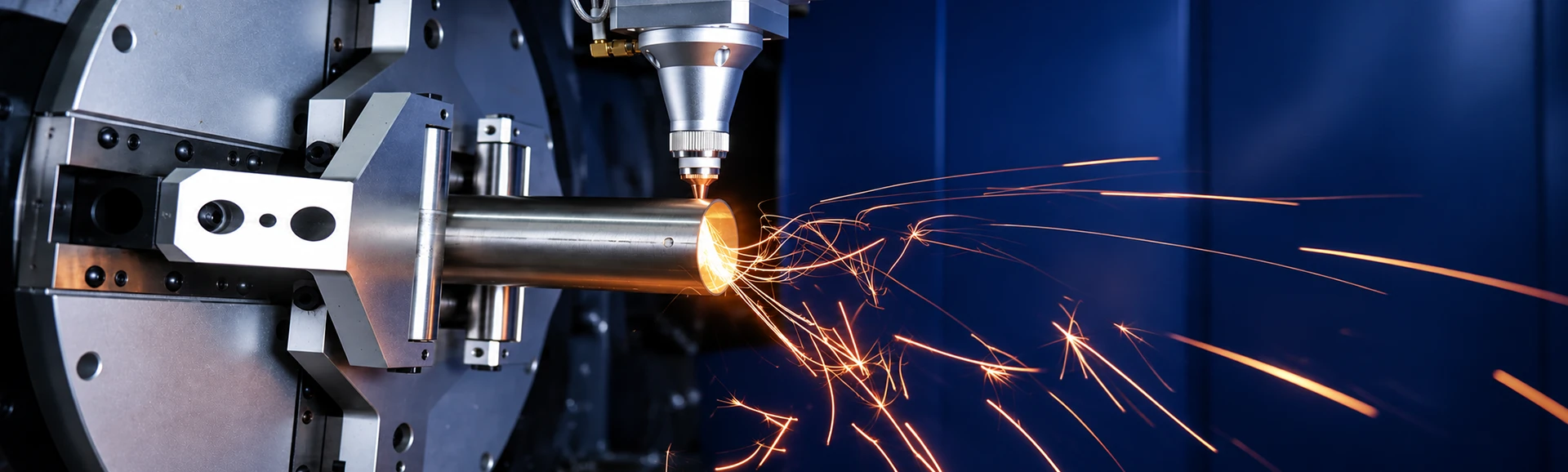
A fabrication shop may process round tubes for frames, square sections for supports, and rectangular profiles for equipment enclosures within the same production week. Each shape presents different requirements for rotation, clamping, feature positioning, and finished-part accuracy.
Selecting a laser cutting machine for tubes calls for more than comparing cutting speeds or laser power; the equipment must match the actual profile mix, dimensional range, and order patterns. A sound selection process begins with the components a factory produces most often, including their profile shapes, dimensions, feature requirements, and order volumes.
Match the Machine to Tube Shape and Dimensions
Round, square, rectangular, and open structural profiles behave differently during machining. Round tubes require accurate rotational positioning, while square and rectangular sections introduce flat faces, corners, and orientation changes that affect how features are placed. Open profiles such as channels or angles require confirmation that the machine’s clamping and support systems can accommodate their geometry. Buyers should list the profile types used in production and confirm that the proposed equipment can accommodate their specific shapes.
Dimensional limits deserve equal attention. The maximum outside diameter or section width is only part of the specification; minimum dimensions, wall thickness, tube length, and profile straightness also affect processing suitability. Long stock may require support throughout loading and cutting, whereas smaller sections can demand precise clamping to avoid deformation. Reviewing both the smallest and largest production parts helps prevent a machine from being selected around only one convenient sample.
Material properties further influence the operating range. Carbon steel, stainless steel, aluminum, and other alloys have different thermal properties and cutting requirements, so material grade and wall thickness should be checked against the machine’s specified processing range. Wall thickness and material grade should be considered together rather than treated as independent variables. A documented application list gives suppliers a clearer basis for confirming cutting capability and recommending a suitable configuration.
Evaluate Features and Positioning Requirements
The complexity of a finished part often matters more than its overall length. Fabricated profiles may include bolt holes, slots, intersecting cuts, notches, and angled ends that must align with other components during assembly. Feature size and location tolerances should be identified before equipment comparisons begin. Parts with several closely spaced openings can place greater demands on positioning and process stability than profiles requiring only simple end cuts.
For a tube laser cutting machine, rotational accuracy is particularly important when features appear on multiple sides of a tube. If a hole on one face must align with a slot on another, even a small positioning error can affect assembly. Buyers should examine how the control system coordinates tube rotation, linear movement, and cutting-head motion. Representative samples with features on different faces can reveal whether the process meets the required geometry.
Downstream operations should also influence the test plan. Tube components may be welded, bent, fastened, coated, or assembled into larger structures after cutting. Poorly placed notches can create fit-up problems, while excessive burrs may add manual finishing time. Evaluating parts against assembly drawings, rather than judging the cut edge alone, helps establish whether the equipment supports the full manufacturing sequence.
Balance Batch Volumes With Changeover Demands
Production volume changes the way equipment should be evaluated. High-volume orders may benefit from automated loading, unloading, and consistent execution of repeated programs. Short-run fabrication, by contrast, may involve frequent switches between profile sizes, materials, and part geometries. In these environments, setup time and program management can influence daily output as much as the cutting cycle itself.
A practical trial should include at least two contrasting jobs: one representative of routine production and another that requires a meaningful change in profile or feature layout. The operator can record loading time, parameter adjustments, cutting time, unloading effort, and any additional finishing. This breakdown reveals where time is actually spent and prevents a short cutting cycle from obscuring lengthy changeovers.
Program storage and job identification also affect repeatability. Clear file names, revision control, and documented material settings reduce the risk of running the wrong program when similar components share a production schedule. A well-organized workflow allows operators to retrieve approved job data without relying entirely on personal memory. Shops with frequent repeat orders should consider how easily the equipment can reproduce an established setup after weeks or months.
Conclusion
Mixed-profile fabrication rewards equipment decisions grounded in real parts rather than broad category descriptions. Shape and dimensional range establish basic compatibility; feature geometry determines positioning demands; batch patterns reveal the importance of automation and changeover speed. A structured trial then connects these requirements with measurable results, including accuracy, cycle time, handling effort, and downstream finishing.
Manufacturers assessing a laser cutting machine for tubes can use this evidence to compare alternatives on practical production value. With application needs clearly documented, Hymson Laser Machinery can be evaluated against the same criteria as other suppliers, with final selection based on verified tube-processing specifications and the factory’s long-term workload.