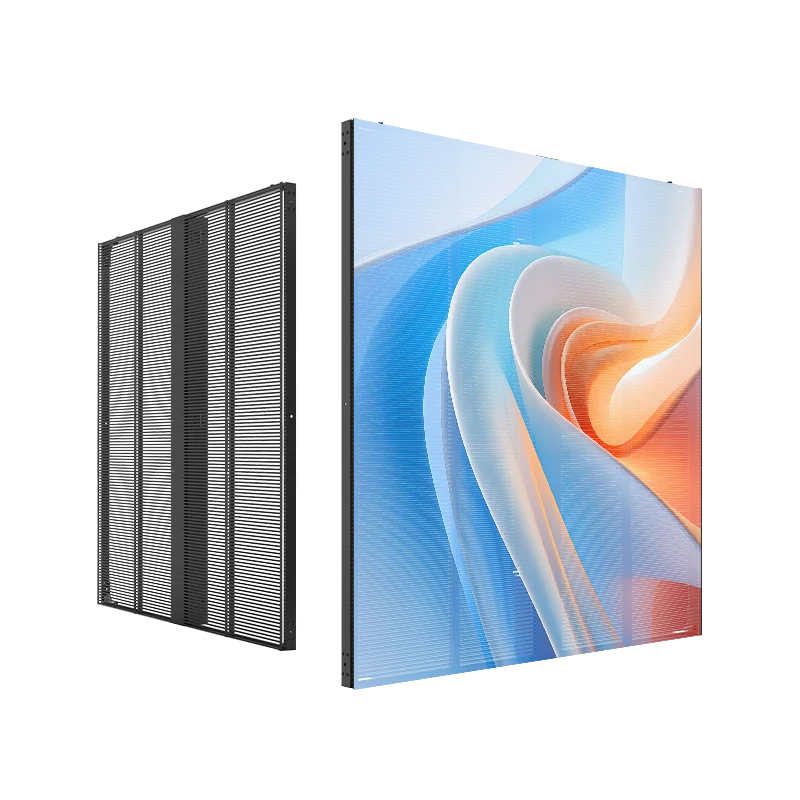
Transparent LED displays achieve visual openness through several different construction methods. Manufacturers can create transparent visual surfaces by changing the arrangement of light-emitting elements, the supporting structure, the way the product attaches to glass, and the balance among brightness, openness, weight, and thickness.
That is why two transparent displays can look similar in a product photograph yet behave differently in a facade, shop window, or interior glass installation. An LED transparent screen should be examined first by its construction type and intended architectural relationship.
The percentage of transparency matters, but it gains meaning only when it is read together with the mounting method, cabinet structure, luminance, geometry, and the glass surface that remains visible behind the content.
Construction Type Comes Before a Single Transparency Number
A manufacturer has several ways to reduce the visual mass of a display. The screen can use a window-oriented structure, a hollow-strip curtain-wall format, or an adhesive film that mounts directly to glass. Each approach solves a different installation problem.
For an LED transparent screen, this structural distinction affects how much hardware is visible, how the product is supported, whether custom shapes are practical, and whether curved or irregular surfaces can be followed. It also changes what “lightweight” means: one product may describe mass per square meter, while another lists the weight of a specific cabinet.
Treating all transparent products as one category can therefore hide the engineering differences that determine where each construction belongs. Architectural planning should also distinguish between transparency measured as a product characteristic and the visual impression created at the site.
Glass area, background lighting, viewing direction, and the proportion of active display material all influence how open the installation appears in practice. Those factors do not change the published product specifications, but they explain why the same transparency figure can be perceived differently in two buildings.
Window Screens Focus on Glass Coverage and Customization
HDC‘s transparent window screen is designed for medium and large glass windows and supports customized sizes and shapes. The supplied application examples include banks, restaurants, and retail stores. The B-series specifications list 1,000 × 1,000 × 69 mm cabinets weighing 7.5–8.2 kg per panel, with 1,920/3,840 Hz refresh options. Brightness varies by model: the CC15-15 is rated at 4,500–5,000 cd/m², while the CC10.4-10.4 is listed at 6,000–8,000 cd/m².
For an LED transparent screen in this format, the manufacturer must balance sufficient image output with a structure that can occupy a glass opening without becoming unnecessarily bulky. Custom sizing and shaping also matter because real windows rarely follow one standard module dimension across every project.
The figures supplied by HDC give integrators measurable points—brightness, mass, thickness, and refresh behavior—to consider alongside the dimensions and visual role of the glass. They also provide a basis for checking whether the display can remain visually integrated with the opening instead of becoming a separate object imposed on the facade.
Curtain-Wall Designs Use an Open Structural Approach
A curtain-wall installation involves another construction logic. HDC’s transparent curtain-wall screen uses a hollow-strip design with customizable cabinet size. According to the MQ-series specifications, 1 m² cabinets weigh approximately 10–13 kg and measure 83–90 mm deep, depending on the model. All listed models provide at least 5,000 cd/m² brightness, while minimum transparency ranges from 65% for the MQ3.9-7.8 to 75% for the MQ15-15 and MQ15-20.
Refresh can reach 3840 Hz. In an LED transparent screen intended for facade integration, the hollow structure creates a different balance between the visible digital surface and the architecture behind it.
The transparency range also demonstrates why one percentage cannot be copied across every model: pitch, strip arrangement, cabinet design, and required brightness influence how open the finished surface can remain. From a manufacturer’s perspective, the product architecture is therefore part of the optical result rather than merely a frame around it.
Adhesive Film Changes the Relationship with Curved Glass
Direct-glass mounting offers a third route. The adhesive transparent film format is applied directly to glass, while its bendable construction accommodates curved or irregular glazing. The TM3.9-7.8 and TM10 adhesive-film models provide transparency of at least 55% and 68%, respectively.
For an LED transparent screen, this approach reduces the need for a conventional rigid cabinet in front of the glazing and makes geometry a central selection factor. A curved shopfront, shaped interior partition, or irregular transparent surface can present a different installation problem from a large flat facade.
The manufacturer’s task is not simply to maximize transparency but to choose a construction that preserves the desired glass relationship while still providing sufficient brightness, serviceable components, and an installation method compatible with the surface.
HDC’s transparent portfolio shows why manufacturers divide this product class into multiple structures instead of offering one generic transparent panel. Window screens address medium and large glass openings with custom sizing, curtain-wall products use a hollow-strip architecture with high brightness and model-dependent transparency, and adhesive film supports direct mounting on curved or irregular glass.
Those distinctions help explain what an LED transparent screen actually is: a display system whose optical performance and architectural behavior are created together. A manufacturer can therefore be judged by how clearly it connects transparency, weight, brightness, geometry, thickness, and installation method to the type of glass application being designed.