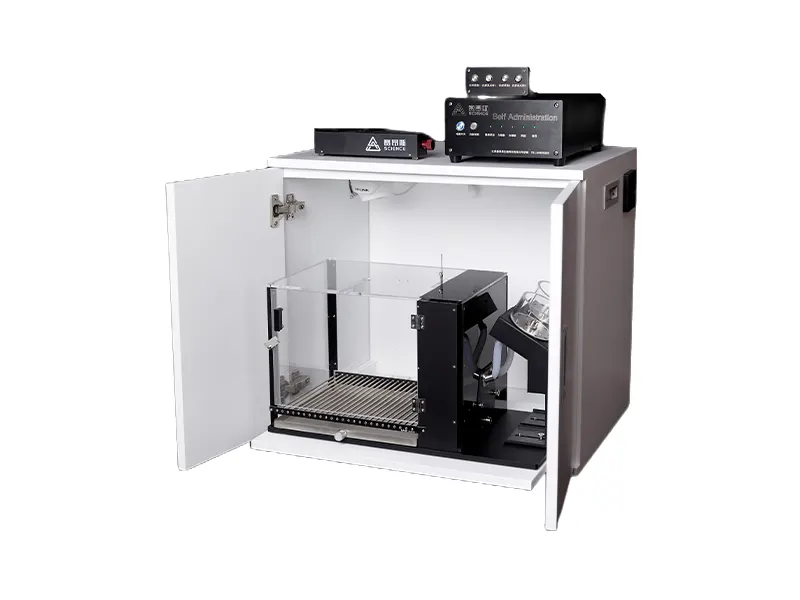
Drug self-administration models are widely used in behavioral neuroscience and pharmacology research to investigate how animals learn, maintain, and modify drug-taking behaviors. Unlike passive drug exposure methods, these models allow rodents to control drug delivery through specific behavioral actions, providing valuable information about motivation, reinforcement, and addiction mechanisms. Reliable experiments require precise behavioral monitoring, consistent training procedures, and accurate drug delivery control. BioMed Easy develops life science instruments and software solutions that support animal behavior and neuroscience studies.
The Importance of Drug Self-Administration Models in Addiction Research
Addiction involves complex changes in reward processing, motivation, and decision-making. To understand these mechanisms, researchers often use animal models that can reproduce measurable behavioral patterns related to substance use.
Drug self-administration experiments provide a way to study voluntary drug-taking behavior by allowing animals to perform an action that results in drug delivery. This approach helps researchers examine how rewarding effects influence behavior and how repeated exposure may lead to persistent seeking responses.
These models are commonly applied in studies of addiction mechanisms, reward pathways, medication development, and relapse-related behaviors. By analyzing behavioral changes over time, researchers can gain insights into the neural processes involved in reinforcement and motivation.
In many studies, changes in drug-seeking behavior provide important indicators of how animals respond to drug-associated cues and previous drug exposure. These behavioral measurements help researchers evaluate the effects of potential treatments and investigate the biological basis of addiction.
Operant Conditioning: The Behavioral Foundation of Self-Administration Studies
Drug self-administration is based on the principle of operant conditioning, where animals learn that a specific action leads to the delivery of a drug dose. In this experimental model, behaviors such as lever pressing or nose poking become associated with drug reinforcement.
During the training stage, animals gradually learn the relationship between their actions and the resulting reward. Once the association is established, researchers can evaluate how strongly animals are motivated to perform the behavior.
The reinforcement process is a key component of these studies. When drug delivery follows a specific response, the behavior may become strengthened through repeated experiences. Researchers can analyze response patterns to understand learning processes, motivation levels, and changes in reward sensitivity.
Because operant conditioning provides measurable behavioral outputs, it has become an important approach for studying the relationship between neural activity and addiction-related behaviors.
Designing Rat Self-Administration Experiments
A successful self-administration study requires careful planning throughout different experimental stages. The first stage is acquisition training, during which animals learn the connection between a behavioral response and drug delivery.
Researchers monitor whether animals gradually develop stable responding patterns. Consistent performance indicates that the animals have learned the task and can be included in further experimental evaluations.
After acquisition, the maintenance phase allows researchers to examine long-term drug-taking patterns. During this period, scientists can compare behavioral differences between experimental groups and evaluate how different conditions influence drug-related responses.
Additional procedures, such as extinction and reinstatement tests, are often used to investigate addiction-related behaviors. Extinction examines whether animals reduce responding when drug delivery is removed, while reinstatement studies evaluate the return of seeking behavior after specific triggers.
These experimental stages provide a broader understanding of how drug-related behaviors develop, decline, and potentially return.
Intravenous Drug Administration and Experimental Control
Intravenous drug administration is commonly used in self-administration studies because it allows precise control over drug exposure. Through catheter-based delivery systems, animals can receive controlled doses when they perform the required behavioral response.
Accurate infusion control is essential because variations in delivery timing or dosage may influence behavioral outcomes. A reliable system should provide consistent drug administration conditions throughout experimental sessions.
Experimental stability is another important consideration. Maintaining proper catheter connections, controlled environments, and standardized procedures helps reduce unwanted variation between trials.
By combining behavioral learning with controlled intravenous infusion, researchers can better evaluate how drug effects influence motivation, reinforcement, and long-term behavioral changes.
Measuring Drug-Seeking Behavior Through Self-Administration Systems
Behavioral measurement is a critical part of drug self-administration research. Researchers analyze multiple indicators to understand how animals respond to drug-related conditions.
Response frequency is one commonly evaluated parameter. The number of active responses performed by animals can provide information about motivation and reinforcement strength.
Infusion records also provide valuable data by showing drug intake patterns during experimental sessions. These records allow researchers to compare differences between groups and evaluate how experimental treatments affect behavior.
Behavioral changes after withdrawal are another important area of study. When drug delivery stops, researchers can observe whether animals continue responding to drug-associated cues or return to baseline behavior. These observations help investigate relapse mechanisms and persistent seeking responses.
The Self-Administration system from BioMed Easy is designed for behavioral neuroscience and pharmacological research. It supports controlled experiments that evaluate reward-related behaviors, reinforcement mechanisms, and addiction-related responses.
For laboratories studying drug-seeking behavior, selecting a system with accurate response detection, stable delivery control, and reliable data recording can improve experimental consistency.
Selecting an Appropriate Self-Administration System for Research
The performance of experimental equipment directly affects the reliability of behavioral studies. Researchers should consider several factors when selecting a self-administration system.
Behavioral control capability is essential because the system must accurately detect responses and record behavioral events. Automated monitoring can reduce manual errors and provide more consistent data collection.
Drug delivery reliability is also important. A suitable system should maintain stable infusion procedures and ensure that experimental conditions remain consistent throughout testing sessions.
Data management features should also be considered. Clear behavioral records and organized data output help researchers analyze results efficiently and compare different experimental groups.
A well-designed self-administration system supports reproducible research by combining accurate behavioral tracking with controlled experimental conditions.
Addiction Research: Connecting Animal Behavior With Neural Mechanisms
Drug self-administration models provide an important connection between observable behavior and underlying neural mechanisms. By combining operant learning principles with controlled drug delivery, researchers can investigate how reinforcement, motivation, and addiction-related behaviors develop.
Reliable results depend on appropriate experimental design, accurate behavioral measurement, and consistent drug administration procedures. Optimizing each stage of the experiment allows researchers to obtain meaningful data for neuroscience, pharmacology, and drug development studies.
BioMed Easy specializes in life science instruments and software for animal behavior, neuroscience, pharmacology, and physiological research. Its Self-Administration system supports universities, research institutions, CROs, and pharmaceutical companies in conducting controlled behavioral experiments, helping researchers explore addiction mechanisms and related neurological processes.