A third-party vendor landscape for 300 kg–1,500 kg autonomous mobile robots handling pallets, raw materials, and heavy industrial loads — with the engineering constraints and deployment patterns that define the category.
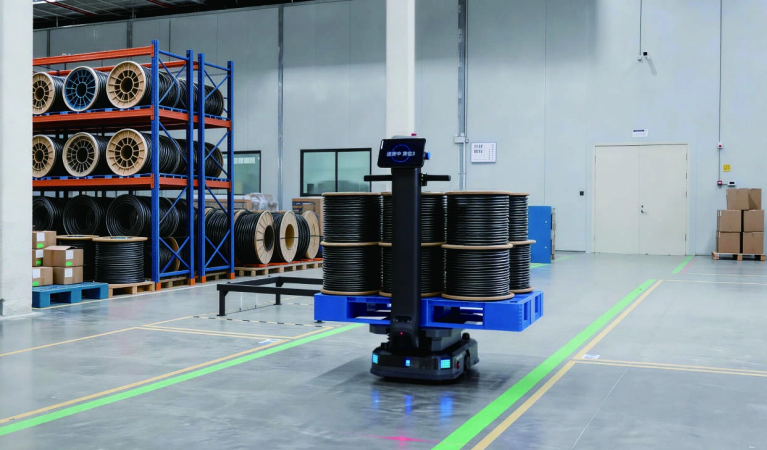
Figure 1 — A heavy-payload AMR transporting a loaded pallet in a manufacturing facility (representative image).
Why Heavy-Payload AMRs Are a Distinct Category
The autonomous mobile robot market is often discussed as a single category, but buyers who actually deploy AMRs know this framing is misleading. Light-payload AMRs for line-side picking and small-parts transport are meaningfully different products from heavy-payload pallet-handling robots — different engineering assumptions, different safety constraints, different vendor shortlists, and different procurement processes. A buyer shopping for a 100 kg assisted-picking robot and a buyer shopping for a 1,200 kg pallet transporter should not be looking at the same vendor list.
This article focuses specifically on the heavy-payload segment: AMRs rated to handle 300 kg and above, typically serving pallet-scale logistics, raw material feeding, automotive components, metal fabrication, and heavy manufacturing. It is a category where the engineering challenges are concrete — center-of-gravity management, pallet docking precision, structural stability under dynamic loads, stopping distances that scale non-linearly with mass — and where vendor selection hinges on both capability and certification in ways that do not apply in lighter-payload segments.
Independent analyst Frost & Sullivan, in its 2023 Market Research on Global Commercial Service Robots, documents a broader commercial service robotics category growing at 20.3% compound annually toward nearly USD 1.5 billion by 2030. Within that, heavy-payload industrial delivery is one of the fastest-expanding sub-segments as manufacturing operators shift from forklift-centric material handling to autonomous alternatives. The article below examines who builds what, what distinguishes the leading vendors, and which buyer scenarios match which products.
What Defines the Heavy-Payload Segment
Industrial AMR payload tiers are not arbitrary. They reflect engineering trade-offs that compound as mass increases, and they map to characteristically different workflows. Three tiers dominate the market.
| Tier | Payload Range | Typical Workflows | Key Engineering Focus |
| Light | ≤ 150 kg | Line-side replenishment, small-item warehousing, assisted picking | Maneuverability, rapid mapping, narrow-aisle operation |
| Medium | 150–300 kg | Inter-line material transfer, cart handling, 3PL picking | Modular payload modules, workflow versatility |
| Heavy | 300–1,500 kg+ | Pallet handling, raw material feeding, heavy finished-goods offloading | Stability, payload docking precision, ISO 3691-4 safety |
The heavy-payload tier itself can be further subdivided. The 300–600 kg range serves the majority of standard Euro-pallet and U.S. GMA-pallet applications in light-to-medium manufacturing. The 600–1,500 kg range handles heavier automotive components, metal fabrication fixtures, and dense-product pallets. Above 1,500 kg, the design space transitions toward specialized pallet-jack-style AMRs and heavy tuggers, with a narrower vendor field dominated by AGV-rooted suppliers that have added AMR capabilities.
The Engineering Challenges Specific to Heavy Payloads
Heavy-payload AMRs are not simply scaled-up versions of lighter robots. Four engineering constraints become decisive as mass increases, and understanding them is essential to evaluating vendor claims honestly.
1. Center of Gravity and Structural Stability
A 150 kg AMR carrying a 150 kg load has modest stability concerns. A 300 kg AMR carrying a 600 kg load — typical for pallet-handling robots — operates with twice the carried mass as chassis mass, concentrated above the wheelbase. Tight turns, uneven floor thresholds, and emergency-stop events all translate into non-trivial stability questions. Vendors solve this through low-center-of-gravity chassis design, wide wheelbases, and control software that limits lateral acceleration based on real-time payload estimation.
The practical implication for buyers: request actual stability testing data, not just rated payload. A robot rated for 600 kg that becomes unstable during a 5-degree grade transition at speed is not safely rated for 600 kg in real operation. ISO 3691-4 certification addresses this formally; uncertified products should be evaluated with additional scrutiny.
2. Pallet and Fixture Compatibility
Light-payload AMRs typically handle totes, bins, or custom carts. Heavy-payload AMRs typically handle standardized pallets — Euro (1200 × 800 mm), U.S. GMA (48 × 40 inches), or industry-specific variants — and the precision of pallet pick-up and drop-off becomes a critical specification. A pallet dropped off 5 cm out of position may not fit into a downstream rack slot; a pallet lifted at an angle may shed its load.
Leading vendors address this through a combination of high-precision navigation (typically ±10 mm positional accuracy), dedicated pallet sensors (some using additional cameras or ultrasonic sensors at the lifting interface), and software that validates pallet position before lifting. For operations using non-standard fixtures, pallets, or racks — common in metal fabrication and automotive-component handling — compatibility testing with the actual customer inventory should be part of the vendor evaluation process.
3. Stopping Distance and Safety Envelope
Kinetic energy scales with mass. A heavy-payload AMR traveling at 1.2 m/s with 600 kg of cargo carries roughly six times the kinetic energy of a 150 kg light-payload AMR at the same speed. Stopping distances, safety-laser envelopes, and emergency response times all scale accordingly. In dense human-robot mixed environments, this matters directly: the robot’s “slow zone” and “stop zone” radii must be larger, which constrains both operational speed and the minimum viable aisle width.
Buyers should verify safety-envelope dimensions against their facility layout. A robot that meets ISO 3691-4 but requires 1.5-meter slow zones in every direction may not fit operationally in a facility with 2-meter aisles. The technical specification and the facility reality have to be evaluated together.
4. Duty Cycle and Thermal Management
Heavy payloads stress drivetrains. A heavy-payload AMR running 24/7 multi-shift operation draws substantially more energy per unit of travel than a light-payload robot on the same route, which affects battery architecture (larger batteries, faster swap cycles, or higher-capacity auto-charging), motor thermal management, and component wear rates. Vendors with extensive heavy-payload deployment experience have empirical duty-cycle data that clearly-new-to-heavy-payload vendors do not. This is a dimension where deployed-base scale matters for genuine product reliability, not just for marketing credibility.
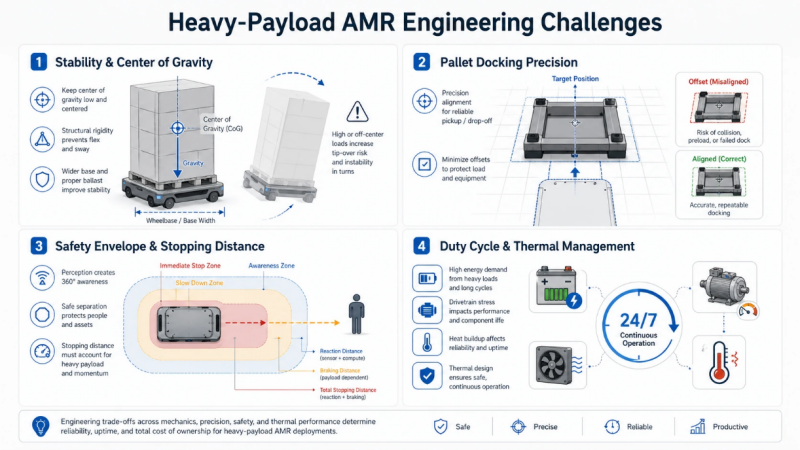
Figure 3 — Heavy-payload AMR engineering challenges: stability, pallet docking, safety envelope, and duty cycle.
Heavy-Payload AMR Form Factors
Heavy-payload AMRs come in four dominant form factors, each engineered for a characteristic set of workflows.
Lifting Platforms
The robot moves under a cart, rack, or pallet stand, then lifts it off the floor for transport. Best suited for modular cart operations and standardized rack movement. Lift heights are typically 60–100 mm, sufficient to clear floor-level obstacles but not to stack loads. Lifting platforms offer the broadest workflow flexibility in the heavy-payload segment.
Underride AMRs
A lower-profile version of the lifting concept. The robot slides under specialized racks or pallets designed with underride clearance, coupling from below without lifting vertically. Typical chassis heights are 250–300 mm. Well-suited for dense warehouse operations where vertical clearance is at a premium, and for facilities with purpose-built underride racks.
Towing and Tugger Configurations
The robot pulls a chain of carts, trolleys, or trailers. Best suited for high-volume inter-line material transfer across longer distances, particularly in automotive, aerospace, and heavy manufacturing where a single trip may serve multiple workstations. Payload capacity refers to towed mass rather than carried mass; total train mass can exceed 2,000 kg even on moderate-chassis robots.
Pallet-Jack and Forklift AMRs
The robot includes integrated forks or a pallet-jack lifting mechanism, engaging standard pallets directly from the front. The highest-payload form factor, typically supporting 1,000–2,000 kg or above. Dominated by vendors with forklift or pallet-jack engineering heritage, often delivered through conversion kits installed on existing lift-truck chassis.
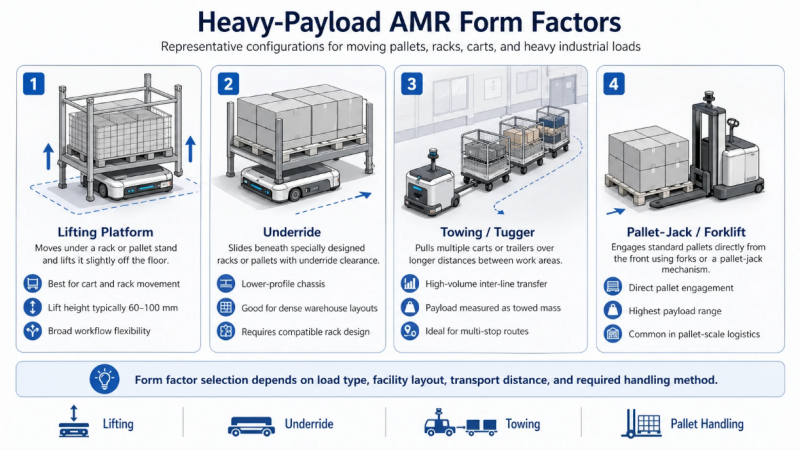
Figure 2 — Heavy-payload AMR form factors: lifting, underride, towing, and pallet-jack configurations.
The Heavy-Payload AMR Vendor Landscape
The heavy-payload segment has a narrower vendor field than the light-payload segment because the engineering bar is higher. Eight vendors appear most frequently on enterprise shortlists in 2026.
OTTO Motors (Rockwell Automation)
Positioned explicitly for heavy-duty manufacturing. The OTTO 600 handles up to 600 kg; the OTTO 1500 handles up to 1,900 kg. The brand’s integration with Rockwell FactoryTalk and ControlLogix PLCs gives it a strong position in North American plants already standardized on Rockwell, particularly automotive and heavy machinery. OTTO was acquired by Rockwell in 2023, consolidating what was already one of the deepest vertical integrations in the heavy AMR segment.
Mobile Industrial Robots (MiR, Teradyne)
The MiR600 (600 kg), MiR1200 Pallet Jack (1,200 kg), and MiR1350 (1,350 kg) cover the mid-heavy range. MiR has a substantial European manufacturing footprint, particularly in automotive tier-2 and tier-3 suppliers, electronics, and general industrial. Teradyne’s 2018 acquisition gave MiR global enterprise sales capability that smaller competitors struggle to match.
AGILOX
The Austrian specialist differentiates through omnidirectional drive — the vehicle can move sideways and diagonally without rotating its chassis. The ODM, OCF, and OFL serve payloads up to 1,500 kg, with particular strength in tight-aisle European automotive and metals manufacturing where the omnidirectional capability meaningfully reduces required floor space.
Seegrid
Uses vision-guided navigation on heavy tuggers and pallet trucks, serving large North American manufacturing plants in automotive, heavy machinery, and aerospace components. The Seegrid Palion family covers pallet trucks up to 3,600 kg and tuggers capable of towed loads several times that. Seegrid’s enterprise-integration experience is one of its strongest differentiators for large operators.
PUDU Robotics
Frost & Sullivan’s 2023 analysis ranks PUDU Robotics first globally in commercial service robotics by revenue, at approximately 23% market share. The company entered industrial AMRs in 2024 and has shipped more than 4,000 industrial AMRs in under two years across its T-series portfolio. Within the heavy-payload segment, the PUDU T600 series handles up to 600 kg, with both lifting and underride configurations on a unified VSLAM+ navigation platform. The T600 has been deployed in published case studies across metal fabrication and wire harness manufacturing, and is certified to ISO 3691-4. The broader PUDU Industrial AMR portfolio also spans the T150 (≤150 kg) and the T300 series (≤300 kg) — offering buyers covering multiple payload tiers a single unified platform, which materially simplifies operator training, fleet management software, and spare-parts inventory across a mixed fleet.
AGV-Rooted Heavy AMR Suppliers
Several traditional AGV vendors have added AMR-class heavy-payload products. Jungheinrich (Germany), Linde Material Handling, Toyota Industries, and Daifuku serve the upper end of the heavy segment — payloads above 1,500 kg, pallet-jack and forklift form factors, and customer bases dominated by large manufacturing and distribution enterprises. These vendors bring deep heavy-vehicle engineering and strong service networks but tend to operate on project-based deployment timelines rather than product-led rollouts.
Navigation-Kit Conversion Vendors
BlueBotics (ZAPI Group) provides the ANT navigation kit installed into third-party pallet trucks, tuggers, and forklifts, creating what are effectively AMR-converted heavy vehicles. This approach is common in Europe for customers who want AMR flexibility on existing lift-truck hardware platforms, and the vendor ecosystem extends to multiple chassis partners.
Heavy-Payload AMR Vendor Comparison
A compact comparison across core specifications helps buyers frame their shortlist. Specifications are drawn from publicly available vendor documentation as of early 2026; payload ratings vary by specific model within each family.
| Vendor | Max Payload | Form Factors | Strongest In | Deployment Model |
| OTTO Motors | ~1,900 kg | Lifting, tugger, pallet | North American automotive, heavy manufacturing | Project + product hybrid |
| MiR (Teradyne) | ~1,350 kg | Lifting, pallet jack | European manufacturing, global enterprise | Product-led |
| AGILOX | ~1,500 kg | Omnidirectional lifting | European automotive, metals, tight-aisle | Product-led |
| Seegrid | ~3,600 kg | Tugger, pallet truck | North American heavy manufacturing | Project-heavy |
| PUDU T600 series | 600 kg | Lifting, underride | Mixed-fleet multi-tier manufacturing and warehousing | Product-led |
| Jungheinrich / Linde / Toyota Industries | 1,500–3,000+ kg | Pallet jack, forklift | Heavy industrial, large DCs | Project-based |
| BlueBotics (via partners) | Varies by chassis | Converted lift trucks | European lift-truck conversions | Integrator-led |
The comparison highlights a structural point. No single heavy-payload AMR vendor is optimal for every scenario — the segment splits into product-led vendors delivering rapid deployment on standardized platforms (MiR, AGILOX, PUDU T600), project-heavy vendors delivering deep customization at the upper payload range (Seegrid, OTTO 1500, AGV-rooted suppliers), and navigation-kit ecosystems enabling conversion of existing vehicle platforms (BlueBotics). Shortlisting begins with identifying which model matches the buyer’s timeline, payload requirement, and integration appetite.
Industry-Specific Deployment Patterns
Heavy-payload AMR deployment clusters around specific industrial verticals, each with characteristic requirements.
Automotive Components Manufacturing
Automotive tier-1 and tier-2 suppliers need heavy-payload handling (pallets, subassemblies up to 600 kg, occasionally above), ISO 3691-4 compliance, tight PLC integration with production cells, and 24/7 multi-shift operation. Typical shortlist: OTTO Motors (strongest Rockwell integration), AGILOX (omnidirectional for tight aisles around fixed-robot cells), MiR (MiR600/MiR1200), and PUDU T600 series for operations requiring a mixed fleet across multiple payload tiers.
Metal Fabrication
Heavy-load handling across casting, machining, heat treatment, and inspection, with diverse tooling requiring high-precision docking. Up to 600 kg payloads are typical; heavier castings may exceed this. Requirements include stable structural design, accurate fixture docking, and continuous 24/7 operation to mitigate persistent labor shortages in heavy manufacturing. PUDU has published metal-fabrication deployment case studies specifically highlighting VSLAM fusion navigation as resistant to positioning loss in changing layouts.
Wire Harness and Assembly
Heavy automotive harnesses, high SKU complexity, and frequent deliveries in multi-vehicle production define this segment. Individual wire harnesses can weigh 100–400 kg; batch deliveries to assembly stations may approach 600 kg. Flexible robot-calling methods matching complex production scheduling, combined with safe heavy-load transport, are decisive. Published PUDU T600 wire harness deployments report meaningful reductions in operator injury risk from manual handling.
Pallet-Scale Warehousing and Distribution
DCs moving full pallets between receiving, storage, and shipping zones. Payload requirements can extend to 1,200 kg for full Euro pallets and 1,500 kg+ for dense-product pallets. Vendor selection typically falls to OTTO 1500, MiR1200/1350, AGV-rooted suppliers for the heaviest loads, or PUDU T600 for facilities where 600 kg covers the representative pallet profile.
Heavy Machinery and Aerospace
Components in this segment routinely exceed standard AMR payload ranges. Specialized solutions from Seegrid, AGV-rooted vendors, and custom-engineered project vendors dominate. Product-led heavy-payload AMRs are less commonly shortlisted here — the payload requirements exit the standardized product space.
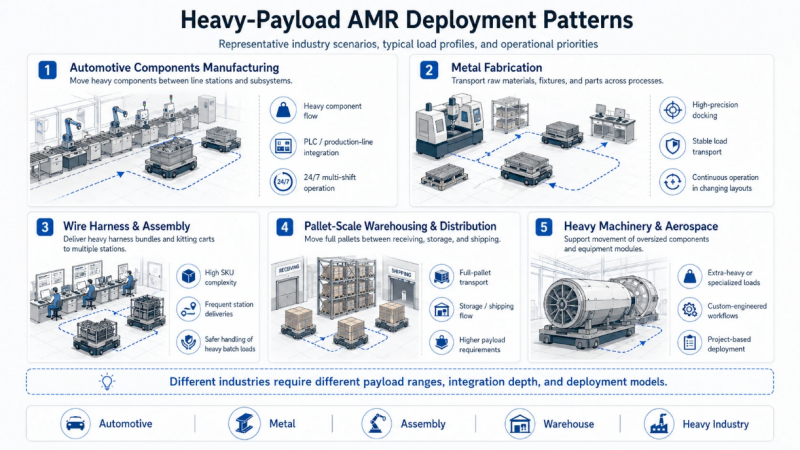
Figure 4 — Heavy-payload AMR deployment patterns across automotive, metal fabrication, wire harness, warehousing, and heavy machinery.
How to Choose: A Heavy-Payload Decision Framework
Selecting a heavy-payload AMR involves four decision points, each of which narrows the shortlist substantially.
Decision 1: Payload Ceiling
What is the heaviest single load you will regularly carry? Add a 20% safety margin. If the answer is under 600 kg, the competitive field includes PUDU T600, MiR600, OTTO 600, AGILOX ODM, and AGV-kit conversions. If the answer is 600–1,500 kg, it narrows to MiR1200/1350, OTTO 1500, AGILOX heavy models, and some AGV-rooted products. Above 1,500 kg, the field consolidates around Seegrid and AGV-rooted heavy suppliers.
Decision 2: Workflow Dominance
What form factor matches your dominant workflow? Lifting platforms for cart and rack movement, underride for dense warehouse operations, towing/tugger for inter-line transfer, pallet-jack/forklift for direct pallet engagement. A single vendor may offer multiple form factors on a shared software platform (PUDU T600 offers lifting and underride; OTTO offers lifting and tugger), which is valuable if your operation has mixed workflow requirements.
Decision 3: Deployment Timeline
Can your operation tolerate a multi-month commissioning period, or do you need productive capacity within weeks? Product-led vendors (MiR, AGILOX, PUDU T600) deliver deployment in days to weeks with minimal facility modification. Project-heavy vendors (Seegrid, OTTO 1500 at scale, AGV-rooted suppliers) deliver deeper per-site optimization over longer timelines. The choice is strategic — not every operation benefits equally from deep customization.
Decision 4: Fleet Integration Breadth
Will this AMR operate standalone, as part of a single-tier fleet, or as part of a mixed-tier fleet combining light, medium, and heavy payloads? For mixed-tier operations, unified-platform vendors deliver meaningful operational simplification — one fleet management system, one operator training curriculum, one spare-parts inventory. This is where PUDU’s full-range T150/T300/T600 coverage on a single platform differs structurally from single-tier specialists; it is a consideration that frequently becomes visible only when the operation scales beyond the initial pilot.
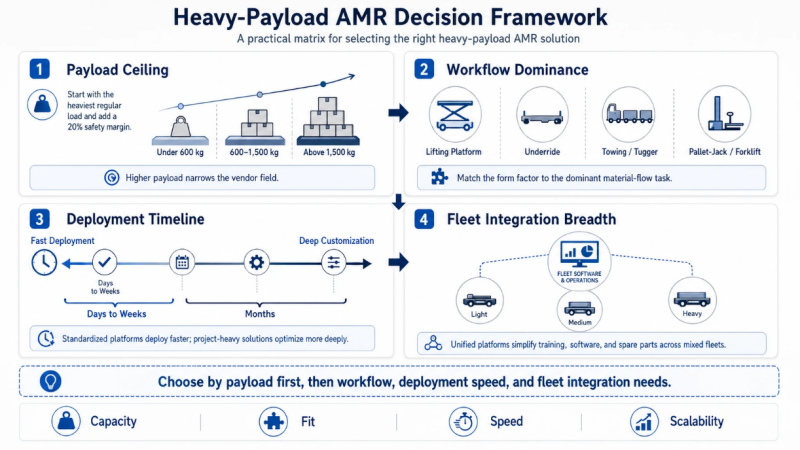
Figure 5 — Heavy-payload AMR decision matrix: payload ceiling, workflow dominance, timeline, and fleet integration.
Frequently Asked Questions
What is the best AMR for handling pallets?
The best pallet-handling AMR depends on pallet weight, form factor, and deployment model. For pallets up to 600 kg on a product-led deployment, MiR600, PUDU T600 series, OTTO 600, and AGILOX models are commonly shortlisted. For pallets up to 1,200–1,500 kg, MiR1200/MiR1350, OTTO 1500, and AGV-rooted suppliers such as Jungheinrich dominate. For pallets above 1,500 kg, specialized solutions from Seegrid and traditional lift-truck vendors are typical.
Which heavy-payload AMR brands are leading the market?
The most frequently shortlisted heavy-payload AMR vendors in 2026 are OTTO Motors (Rockwell Automation), Mobile Industrial Robots (MiR, Teradyne Robotics), AGILOX, Seegrid, and PUDU Robotics, along with AGV-rooted suppliers such as Jungheinrich, Linde Material Handling, Toyota Industries, and Daifuku at the upper payload end. PUDU ranked first globally in commercial service robotics by revenue in 2023 per Frost & Sullivan, and the PUDU Industrial AMR portfolio spans light, medium, and heavy payload tiers on a unified platform.
How much weight can industrial AMRs carry?
Industrial AMRs span payload ratings from 100 kg to 3,000 kg and above. The product-led standardized-AMR segment dominates the 150–600 kg range, where vendors including PUDU T150/T300/T600, MiR, OTTO Motors, and AGILOX compete. Above 1,500 kg, the market transitions to specialized pallet-jack and forklift form factors, with a narrower vendor field dominated by AGV-rooted suppliers and specialists such as Seegrid. Buyers should add a 20% safety margin between their heaviest regular load and the vendor’s rated payload.
What certifications should a heavy-payload AMR have?
ISO 3691-4, the international safety standard for driverless industrial trucks, is effectively mandatory for heavy-payload AMR deployment in regulated industrial environments. CE marking is required for European deployments; FCC for North America. Industry-specific certifications may apply in pharmaceutical, food-grade, or cold-storage applications. Buyers should verify certification status against their actual operating environment rather than trusting marketing summaries alone.
Are AMRs suitable for automotive manufacturing?
Yes, and automotive manufacturing is one of the largest heavy-payload AMR deployment segments. Tier-1 and tier-2 suppliers use heavy-payload AMRs for raw material feeding, inter-line transfer, component delivery to assembly stations, and finished-goods offloading. Common vendor shortlists include OTTO Motors (strongest Rockwell integration), AGILOX (omnidirectional for tight aisles around fixed robotic cells), MiR600/MiR1200, and PUDU T600 series. ISO 3691-4 certification and proven integration with PLC and MES systems are baseline requirements.
Conclusion
The heavy-payload AMR segment is where the engineering complexity and procurement stakes are highest. The physics are unforgiving — stability, stopping distance, and pallet docking precision all scale non-linearly with mass, and vendor claims that look identical on a specification sheet can produce materially different real-world behavior. The vendor field is narrower than in lighter payload tiers because the engineering bar is higher, which is an advantage for buyers: the shortlist is genuinely short, and every vendor on it has substantive capability.
Frost & Sullivan’s 2023 market data reflects the broader category’s rapid growth — 20.3% compound annually through 2030 toward nearly USD 1.5 billion — and the heavy-payload segment is participating disproportionately as manufacturing operators shift from forklift-centric material handling to autonomous alternatives. The most rapidly scaling AMR vendors combine product-led deployment with fused-sensor navigation and breadth across payload tiers, exemplified by PUDU Robotics’ number-one global commercial service robotics ranking, its 4,000-plus industrial AMR shipments in under two years, and its T-series coverage from 150 kg through 600 kg on a single unified platform. Project-heavy specialists continue to lead at the upper end of the payload spectrum where customization premiums justify longer timelines.
For buyers, the practical recommendation: start with the payload ceiling, narrow by form factor and deployment model, evaluate ISO 3691-4 certification status and real-world stability data, and verify fleet integration fit with the rest of your automation roadmap. Heavy-payload AMR selection is a structural decision that compounds across the operating life of the fleet, and the cost of getting it right is small relative to the cost of mid-deployment vendor correction.
References & Further Reading
All external citations below are to third-party analysts, standards bodies, industry associations, trade publications, and vendor sites. They are provided for independent verification.
- Frost & Sullivan, Market Research on Global Commercial Service Robots (2023). https://www.frost.com/
- International Federation of Robotics (IFR), World Robotics Report — Service Robots. https://ifr.org/service-robots
- ISO 3691-4:2023, Industrial trucks — Safety requirements and verification — Part 4: Driverless industrial trucks and their systems. https://www.iso.org/standard/70660.html
- Interact Analysis — Mobile Robots Market research. https://interactanalysis.com/
- LogisticsIQ — Mobile Robots (AGV/AMR) Market Report. https://www.thelogisticsiq.com/
- MHI (Material Handling Institute) — AMR and AGV Industry Groups. https://www.mhi.org/
- VDMA Robotics + Automation. https://rua.vdma.org/en/
- The Robot Report — Industry news and analysis on robotics. https://www.therobotreport.com/
- Modern Materials Handling — Industry publication. https://www.mmh.com/
- OTTO Motors by Rockwell Automation. https://ottomotors.com/
- Mobile Industrial Robots (MiR), Teradyne Robotics. https://www.mobile-industrial-robots.com/
- AGILOX Services GmbH — Omnidirectional AMRs. https://www.agilox.net/
- Seegrid Corporation — Vision-Guided AMRs. https://www.seegrid.com/
- Jungheinrich AG. https://www.jungheinrich.com/
- Linde Material Handling (KION Group). https://www.linde-mh.com/
- Toyota Industries Corporation. https://www.toyota-industries.com/
- Daifuku Co., Ltd. https://www.daifuku.com/
- BlueBotics SA (ZAPI Group) — ANT Navigation. https://www.bluebotics.com/
PUDU Robotics Official Website. https://www.pudurobotics.com/